

Chronic Skin Disease Treatment Options: 2026 Guide
Posted by Editorial Team on
Table of Contents
- Building a Treatment Plan for Chronic Skin Disease
- Eczema Treatment Options: From Barriers to Biologics
- Psoriasis Treatment Options: Topicals to Systemic Therapy
- Phototherapy for Chronic Skin Disease: UVB, PUVA, and Lasers
- Chronic Itch Management and Skin-Barrier Support
- Choosing a Treatment Pathway: Benefits, Risks, and Cost
- Frequently Asked Questions
Last Updated: October 5, 2026
Building a Treatment Plan for Chronic Skin Disease
Chronic skin disease is a long-term inflammatory condition requiring ongoing management rather than a single cure.
That's the core problem with most treatment searches: people look for a single fix for a condition that behaves more like a chronic illness.
Below, we break down treatment options for chronic skin diseases, condition by condition, so you can build a plan that matches your skin.
Eczema Treatment Options: From Barriers to Biologics
Eczema treatment starts with repairing the skin barrier, then escalates to anti-inflammatory and immune-targeted therapy when barrier care alone isn't enough. Atopic dermatitis, the most common form of eczema, responds well to a stepped approach.
Topical and Oral Therapies for Eczema
Topical treatment is the first line for most eczema. Options include:
- Moisturizers and barrier creams applied at least twice daily, including immediately after bathing
- Topical corticosteroids for short bursts during flares, matched to skin thickness and body site
- Topical calcineurin inhibitors for sensitive areas such as the face and eyelids
Oral options enter when topicals stop controlling symptoms. Oral antibiotics are sometimes used when secondary bacterial infection drives a flare; oral corticosteroids are generally avoided long-term because of rebound flares.
Biologics and Targeted Immune Treatments
Biologic therapy targets specific immune pathways rather than suppressing the whole immune system. For eczema, the best-established target is the IL-4 receptor alpha subunit, central to the type 2 immune response that drives atopic dermatitis.
Dupilumab is the most widely recognized monoclonal antibody in this class, given as a subcutaneous injection and typically reserved for moderate to severe atopic dermatitis that hasn't responded to topicals.
Psoriasis Treatment Options: Topicals to Systemic Therapy
Psoriasis treatment follows a stepwise escalation, but the threshold for systemic therapy is lower than in eczema because psoriasis is a systemic inflammatory disease linked to joint involvement, cardiovascular risk, and metabolic syndrome. Mild disease, under 3-5% of body surface area, often stays on topicals indefinitely, while moderate to severe disease, or any with joint pain or nail involvement, usually needs systemic therapy or phototherapy.
Topical Treatment for Mild to Moderate Psoriasis
Topical therapy remains the backbone for limited plaques. The main options are:
- Corticosteroids (e.g., clobetasol, betamethasone) to reduce inflammation and scaling; potency is matched to body site, with lower-potency agents used on the face and intertriginous areas
- Vitamin D analogues (e.g., calcipotriene) to slow keratinocyte turnover; often combined with a corticosteroid to improve efficacy and reduce irritation
- Retinoids such as tazarotene, particularly for scalp and nail psoriasis, though pregnancy risk requires careful counseling
A common pattern uses a corticosteroid during flares and a vitamin D analogue or non-steroidal agent for maintenance, reducing steroid exposure.
Phototherapy as a Middle-Tier Option
Phototherapy sits between topicals and systemic drugs. Narrowband UVB, the most common form, is typically given two to three times weekly for 12-24 sessions before tapering, and suits widespread plaques too extensive for topicals but not severe enough for immune suppression. PUVA (psoralen plus UVA) is more effective for some patients but carries higher long-term skin cancer risk, so it's usually reserved for UVB failures.
Oral and Systemic Medications for Psoriasis
Systemic therapy is indicated when topicals and phototherapy fail, when disease is widespread, or when psoriatic arthritis is present. The main categories are:
- Methotrexate: a long-established immunosuppressant, typically dosed weekly with folic acid supplementation; requires regular bloodwork to monitor liver enzymes and blood counts
- Cyclosporine: used for rapid control in severe flares; limited to short-term use because of kidney toxicity and blood pressure elevation
- Oral retinoids such as acitretin: effective for pustular and erythrodermic psoriasis; requires pregnancy prevention and lipid monitoring
Monitoring and Escalation
Monitoring burden varies by agent. Methotrexate requires liver function tests and complete blood counts every 8-12 weeks once stable. Biologics require baseline tuberculosis and hepatitis screening, then periodic infection monitoring. JAK inhibitors require lipid and blood count monitoring, plus vigilance for infection or clotting. A common escalation path is topical → phototherapy → oral systemic → biologic → JAK inhibitor, but the order can shift based on comorbidities, patient preference, and insurance coverage.
| Treatment Tier | Typical Use | Examples | Monitoring Needed |
|---|---|---|---|
| Topical | Mild, limited disease | Corticosteroids, vitamin D analogues, roflumilast | Low |
| Phototherapy | Moderate disease, widespread patches | Narrowband UVB, PUVA, excimer laser | Moderate (skin checks) |
| Oral systemic | Moderate to severe disease | Methotrexate, cyclosporine, apremilast | Regular bloodwork |
| Biologics | Moderate to severe, failed systemics | TNF, IL-17, IL-23 inhibitors | Infection screening, periodic labs |
| JAK inhibitors | Refractory disease, psoriatic arthritis | Tofacitinib, upadacitinib | Lipid and blood count monitoring |
Hormonal therapy is not a psoriasis treatment, but hormonal shifts can influence disease activity in some people, worth raising with your dermatologist if you notice a pattern.
Phototherapy for Chronic Skin Disease: UVB, PUVA, and Lasers
Phototherapy for chronic skin disease uses controlled ultraviolet light to reduce inflammation and slow abnormal skin cell turnover. It's a middle-tier option: stronger than topicals, gentler than most systemic drugs, and it avoids the immune suppression of biologics.
The main forms are:
- Narrowband UVB, the most common choice for psoriasis and widespread eczema
- Broadband UVB, used less often today
- PUVA, which combines a psoralen drug with UVA light
Photochemotherapy (PUVA) is effective but carries higher long-term skin cancer risk than narrowband UVB, so it's usually reserved for cases where UVB hasn't worked. Treatment runs two to three sessions weekly for several weeks, then tapers to maintenance.
Chronic Itch Management and Skin-Barrier Support
Chronic itch management works best when it targets both the nerve signaling behind the itch and the barrier damage that keeps triggering it. Scratching damages the barrier further, increasing inflammation and itch, breaking that loop is the goal.
Nature's Gift Eczema/Psoriasis Cleanse Cream 1.5oz →
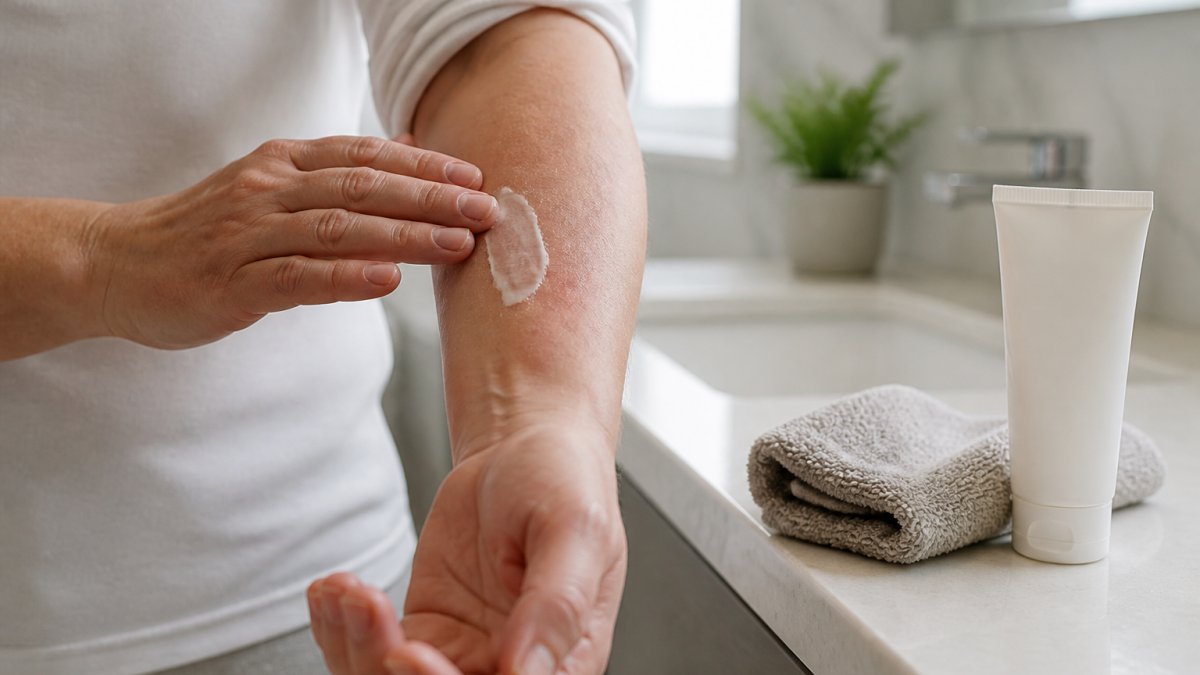
Practical approaches include:
- Cool compresses and cool showers during flare-ups
- Relaxation techniques such as paced breathing, which reduce the stress component of itch
- Behavioral approaches, including habit reversal for unconscious scratching
Daily Deep-Cleansing and Moisturizing Routine
A consistent routine does more for long-term control than any single product. Our approach at Get Your Life Back LLC centers on deep cleaning followed by immediate hydration, because debris left in pores and on the skin keeps irritation going.
A workable daily sequence:
- Cleanse with a gentle, non-comedogenic cleanser or bar
- Pat skin almost dry, leaving it slightly damp
- Apply moisturizer within three minutes to lock in water
- Reapply to hands and any exposed areas through the day
- Repeat the full routine after any sweating or showering
For stubborn scaling and debris, our Nature's Gift Eczema/Psoriasis Cleanse Cream is designed to be massaged into damp skin until it absorbs fully, followed by the Pre-Wash Solution to re-wet and repeat the process. The American Academy of Dermatology's guidance on bathing and moisturizing reinforces the same principle: soak, then seal.

Choosing a Treatment Pathway: Benefits, Risks, and Cost
Choosing a treatment pathway means weighing how well each option controls your disease against its risks, monitoring burden, and cost. There's no universally correct order, but a sensible default is to start with the least invasive option that controls your symptoms and escalate only when it stops working. What most summaries skip is the practical detail: how long to wait before escalating, what monitoring involves, and how to navigate access and cost.
A Stepwise Escalation Framework
A common clinical pathway moves through four tiers:
- Barrier care and trigger management, daily moisturizing, gentle cleansers, trigger avoidance. This is the foundation and continues at every tier.
- Topical therapy, corticosteroids, calcineurin inhibitors, vitamin D analogues, or non-steroidal options. Expect 2-4 weeks to see meaningful improvement. If topicals fail after 4-6 weeks of consistent use, escalation is reasonable.
- Phototherapy or systemic therapy, narrowband UVB, methotrexate, apremilast, or biologics. Phototherapy typically shows response in 4-8 weeks; systemics may take 8-12 weeks for full effect. Reassessment at 12-16 weeks is standard.
- Advanced therapies, biologics or JAK inhibitors for refractory disease. Response is often faster (4-8 weeks for many biologics), but prior authorization and screening can add weeks before the first dose.
Escalation isn't always upward. Some patients step down after achieving control, moving from a biologic to a lower-frequency maintenance dose or from phototherapy to topicals. The goal is control with the least cumulative risk.
Benefits, Risks, and Monitoring at a Glance
- Topicals: Low cost, low risk, but adherence is the real problem, most people under-apply or stop too early. No routine bloodwork needed.
- Phototherapy: Effective for widespread disease, avoids immune suppression, but requires 2-3 sessions per week and carries a dose-dependent skin cancer risk with long-term use. Annual skin checks are prudent.
- Oral systemics: Methotrexate requires liver and blood count monitoring every 8-12 weeks; cyclosporine is limited to short-term use due to kidney and blood pressure effects; apremilast is better tolerated but less effective for severe disease.
Practical Access and Cost Considerations
Cost and access are genuine barriers that rarely get discussed:
- Prior authorization: Most biologics and JAK inhibitors require prior authorization. Ask your dermatologist's office about timelines, it can take 2-4 weeks or longer.
- Patient assistance programs: Most biologic manufacturers offer copay assistance or free drug programs for eligible patients. Ask your dermatologist or check the manufacturer's website.
- Phototherapy access: Phototherapy is often covered by insurance but may require in-network facility visits. Home phototherapy units are an option for some patients but may not be covered.
The National Institute of Arthritis and Musculoskeletal and Skin Diseases publishes plain-language overviews of psoriasis and eczema that are useful for these conversations.
Realistic Expectations and Evidence Quality
It's important to distinguish established medical treatments from complementary approaches. Topicals, phototherapy, systemics, biologics, and JAK inhibitors have been studied in randomized controlled trials and have defined efficacy and safety profiles.
Control, not cure, is the realistic goal for most chronic skin diseases. Improvement typically takes weeks, not days, often gradual over 4-12 weeks, with flares still possible even on effective therapy.
For daily barrier support between treatments, our Nature's Gift Skin Lotion is a coconut oil-based moisturizer built around a sub-molecular bio-form carbon concentrate. Applied to damp skin and massaged in until the visible whiteness disappears, it's non-comedogenic and hypoallergenic, meant to work alongside your doctor's medical regime, not replace it. Our Eczema/Psoriasis Cleanse Lotion follows the same principle for scaly, thickened skin.

Frequently Asked Questions
What treatments are commonly used for chronic skin conditions?
Most chronic skin disease plans combine a few approaches. Topical medications such as corticosteroids, calcineurin inhibitors, PDE4 inhibitors, or topical JAK inhibitors calm inflammation on the skin. Oral or systemic medications, including methotrexate, retinoids, and biologics like monoclonal antibodies, are used when topicals are not enough. Phototherapy with narrowband UVB or PUVA, plus daily skin-barrier support with moisturizers and gentle cleansing, rounds out a typical regimen.
When is phototherapy used for chronic skin disease?
Phototherapy for chronic skin disease is usually offered when topical treatments have not controlled symptoms or when large areas of skin are affected. Narrowband UVB is the most common form, while PUVA combines a photosensitizing drug with UVA light for more stubborn cases. Treatment typically involves two to three sessions per week at a dermatologist's office, with gradual dose adjustments based on how your skin responds.
Can lifestyle changes help manage chronic skin inflammation?
Lifestyle changes support, but do not replace, medical treatment. Avoiding known triggers, using fragrance-free moisturizers, managing stress through relaxation techniques, and getting consistent sleep can reduce flare frequency. For chronic itch management, cool compresses and gentle, non-comedogenic cleansers help. Some people also find that an environmental approach, such as a humidifier or removing harsh soaps, eases irritation between medical appointments.
When should someone with a chronic skin condition see a dermatologist?
See a dermatologist if symptoms persist after several weeks of over-the-counter care, if itching disrupts sleep, or if the affected area spreads or shows signs of infection. A dermatologist can confirm the diagnosis, rule out other inflammatory skin diseases, and match you with the right treatment modality, from topical medication to biologic therapy. Early specialist input often prevents years of trial-and-error.
Are natural or plant-based products useful alongside medical treatment?
Plant-based, hypoallergenic products can support skin-barrier function without replacing prescribed therapy. Products such as Nature's Gift Eczema/Psoriasis Cleanse Cream and the Eczema/Psoriasis Pre-Wash Solution are designed to deep clean and hydrate skin, and the brand notes they are intended to enhance, not replace, a doctor's regime. Always check ingredients with your dermatologist, especially if you have sensitive skin or known allergies.
How much do chronic skin disease treatments cost?
Costs vary widely by treatment type and insurance coverage. Topical medications are generally the least expensive, while biologic therapies and phototherapy sessions cost more and may require prior authorization. Practical access options include manufacturer copay programs, dermatology clinics that offer sliding-scale phototherapy, and starting with lower-cost topicals before escalating. Ask your dermatologist's office about financial assistance before ruling out a treatment.
Managing a chronic skin disease is a long game, and the plan that works is the one you can actually keep up with week after week. Get Your Life Back LLC builds products around that reality: deep-cleaning formulas that remove debris from pores, plant-based ingredients that support normal skin function, and a routine simple enough to repeat daily. Explore our Nature's Gift line and see how a consistent cleansing and moisturizing routine fits alongside your dermatologist's plan.
Share this post
- Tags: chronic itch management, chronic skin disease, eczema treatment options, phototherapy for chronic skin disease, psoriasis treatment options, what are the treatment options for chronic skin diseases?