

Liquid Bio-Form Carbon for Skin Health: A 2026 Guide
Posted by Editorial Team on
Table of Contents
- Understanding Liquid Bio-Form Carbon for Skin Health
- How Liquid Bio-Form Carbon Works: The Science of Deep Cleaning
- Natural Skin Detox: Supporting Your Skin's Barrier
- How to Deep Clean Pores Naturally with Carbon
- Debriding Soap for Skin Health: What to Expect
- Safety Profile and Who Should Use Liquid Bio-Form Carbon
- Conclusion: Choosing the Right Carbon Product for Your Skin
- Frequently Asked Questions
Last Updated: October 1, 2026
Understanding Liquid Bio-Form Carbon for Skin Health
Liquid bio-form carbon for skin health is a plant-derived carbon suspension engineered to bind impurities at a particle size small enough to work inside congested pores. At Get Your Life Back LLC, we built our Nature's Gift® Debriding Soap around this material.
What Makes Liquid Bio-Form Carbon Different
Liquid bio-form carbon is a renewable, plant-based carbon processed into a liquid suspension rather than a dry powder or solid bar additive. The difference is particle size.
Three practical consequences follow from that size difference:
- Deeper contact: the suspension reaches the t-zone and nasal folds where sebum absorption matters most
- No grit: there is nothing abrasive to scratch the skin barrier
- Even distribution: liquid carbon spreads across the face instead of clumping in one area
FDA guidance on cosmetic ingredient safety and labeling
How Liquid Bio-Form Carbon Works: The Science of Deep Cleaning
Carbon works through adsorption: impurities stick to its surface and are carried away when you rinse. This is a physical process, not a chemical peel, and it does not depend on acids or heat.
Why "Liquid" Carbon Is Chemically Different From Powder
Most charcoal skincare is built on dry activated carbon powder, the same material used in water filters. Powder is cheap, stable, and easy to press into a bar, which is why so many charcoal products underperform.
- Particle size. Powdered activated carbon typically ranges from roughly 1 to 100 micrometers. A liquid bio-form suspension is engineered down to the nanoscale, our process produces particles at 6 angstroms, or 0.6 nanometers. That is roughly 1,000 to 100,000 times smaller than conventional powder.
- Dispersion. Powder clumps when it meets water. Clumps behave like grit: they sit on the surface and rinse away before they contact a pore. A true suspension keeps particles separated so each one can travel independently.
- Surface area per gram. Adsorption capacity scales with accessible surface area. The smaller and more evenly dispersed the particles, the more total surface is exposed to oil and debris at any moment.
Particle Size and Skin Penetration
Particle size determines whether a carbon cleanser reaches pore congestion or just cleans the surface. At 0.6 nanometers, liquid bio-form carbon sits far below the threshold where particles begin to clog pores themselves, which is why our formulas are non-comedogenic.
| Cleansing Method | Mechanism | Best For | Main Limitation |
|---|---|---|---|
| Liquid bio-form carbon | Adsorption at 0.6 nm | Pore congestion, oily t-zone | Requires consistent use |
| Powdered charcoal | Adsorption at 1-100 µm | Surface oil control | Too large to enter pores |
| Bentonite clay | Oil absorption | Surface oil control | Can over-dry skin |
| Salicylic acid | Chemical exfoliation | Blackheads, mild acne | Irritates sensitive skin |
| Mechanical scrub | Physical abrasion | Dull surface texture | Cannot reach pore depth |
Delivery Systems: Why Format Changes Performance
Two products can both say "charcoal" on the label and behave nothing alike. The delivery format decides how much carbon reaches the skin.
- Bar soap with charcoal chunks. The carbon is embedded in a solid matrix. Most of it never leaves the bar, and what does leave arrives as visible grit.
- Charcoal powder masks. High carbon load, but the powder sits on the surface for 10-15 minutes and is rinsed before it can work at pore depth. Good for surface oil, limited for congestion.
- Charcoal-infused creams and lotions. Low carbon concentration, often below the level needed for meaningful adsorption. The charcoal is frequently a colorant, not an active.
- Liquid bio-form carbon cleansers. The carbon is pre-suspended at a controlled particle size, so it contacts skin evenly and rinses clean without grit or residue.
Natural Skin Detox: Supporting Your Skin's Barrier
Natural skin detox is not about stripping the skin bare. It is about removing what blocks normal function so the barrier can do its job.
Signs your skin barrier is functioning well after cleansing:
- Skin feels soft rather than tight
- No redness or stinging within ten minutes
- Oil returns gradually over several hours, not immediately
- Texture looks even under natural light
How to Deep Clean Pores Naturally with Carbon
Cleaning pores naturally with carbon takes about three minutes and works best as a consistent routine. Frequency matters more than intensity.
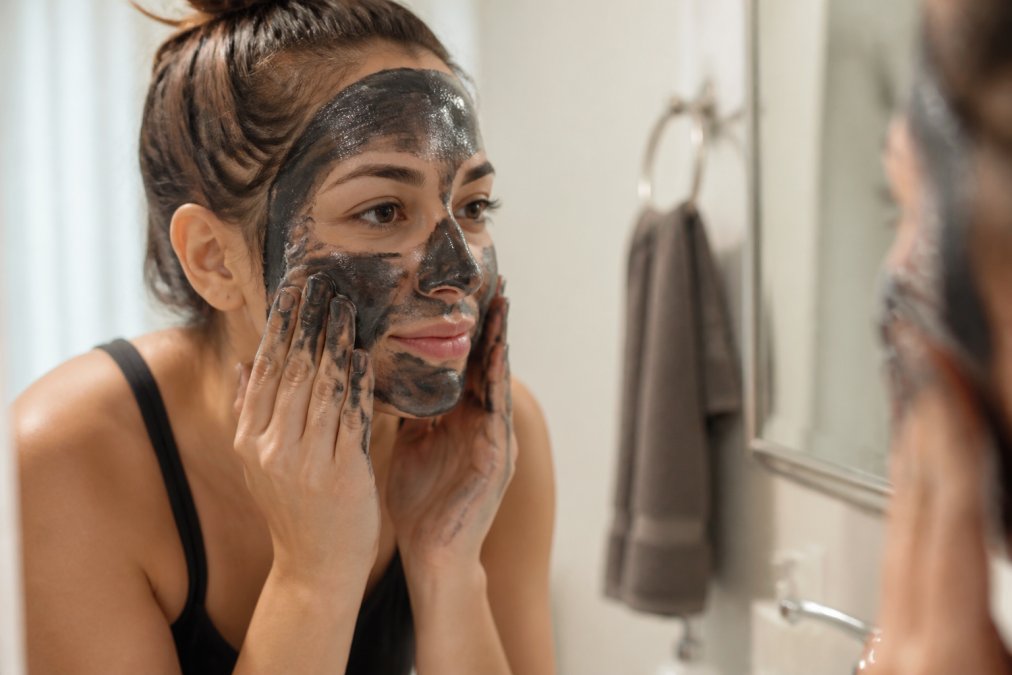
Step-by-Step Application Guide
Total time: 3-4 minutes Difficulty: Beginner
What you'll need:
- Liquid bio-form carbon cleanser
- Lukewarm water
- Clean hands or a soft cleansing cloth
- Moisturizer for after
Step 1: Wet the skin [30 seconds] Splash lukewarm water across the face. Hot water strips lipids before the cleanser even touches your skin.
Debriding Soap for Skin Health: What to Expect
Debriding soap for skin health removes debris from the skin surface and within pores, a different job from ordinary cleansing. The term comes from wound care, where debridement means clearing material that interferes with healing.
What to expect in practice, week by week:
- Days 1-3: skin feels cleaner; some people notice a temporary increase in surface oil as the barrier adjusts
- Week 1-2: texture smooths, particularly around the nose and chin
- Week 3-4: tone looks more even and pores appear smaller because they are less congested
Safety Profile and Who Should Use Liquid Bio-Form Carbon
Liquid bio-form carbon is generally well tolerated because it works physically rather than chemically, with no acids, no heat, and no abrasives. Our formulas are hypoallergenic and non-comedogenic, built for people whose skin has already rejected conventional treatments. That said, "natural" is not the same as "risk-free for everyone."
Barrier Disruption and pH: The Real Risks
Carbon itself is inert, it does not strip the skin barrier the way a strong surfactant or an acid does. The risk comes from everything around the carbon.
- Surfactant load. A charcoal cleanser is still a cleanser. If the base uses harsh sulfates, the barrier damage comes from the surfactant, not the carbon, which is why we formulate with gentler cleansing agents.
- pH drift. Healthy skin sits around pH 4.5-5.5. Repeated use of alkaline bar soaps, charcoal bars included, can push pH upward, weakening the acid mantle. A well-formulated liquid carbon cleanser should sit close to skin's natural pH.
- Over-cleansing. The most common self-inflicted problem: washing more than twice daily with any deep-cleansing product strips the lipid matrix faster than skin can rebuild it, and rebound oil makes pores look worse.
- Contact irritation. Rare but possible. With a history of contact dermatitis, patch-test on the inner forearm for 24 hours before facial use.
Who Tends to Benefit Most
- People with oily or acne-prone skin dealing with persistent pore congestion
- Those with sensitive skin who react to acids and fragrances
- Anyone managing chronic irritation who needs a gentle daily cleanser
- People seeking anti-aging support without retinoid irritation
Who Should Be Cautious or Skip It
- Active eczema or psoriasis flares. Broken or inflamed skin needs a clinician's plan, not a new cleanser.
- Open wounds, cuts, or recent chemical peels. Wait until the skin has fully closed before introducing any deep-cleansing product.
- Known sensitivity to any ingredient in the base formula. Read the full INCI list, not just the front label.
- Anyone on prescription retinoids or isotretinoin. Ask your dermatologist before layering a deep-cleansing carbon wash on top of an already-thinned barrier.
Where carbon falls short: it will not replace prescription treatment for active infection and does not address internal causes of skin conditions. It removes one contributor rather than curing a condition, if you have an undiagnosed skin issue, see a clinician first.
American Academy of Dermatology guidance on gentle skin cleansing
Conclusion: Choosing the Right Carbon Product for Your Skin
The carbon cleanser market rewards label-reading. "Charcoal" on a package tells you almost nothing about particle size, suspension quality, or whether the product reaches pore depth. Look for a stated particle size, a plant-based source, and a verifiable non-comedogenic claim.
Frequently Asked Questions
Does charcoal draw out toxins on skin?
Activated charcoal and liquid bio-form carbon work by adsorption, not absorption. The porous structure traps impurities, excess oil, and surface debris on the skin. Research shows charcoal can bind to certain molecules, though the term 'toxins' is often used loosely. For skin health, the practical benefit is removing pore congestion and environmental particles that can irritate skin. Liquid bio-form carbon, with its 6-angstrom particle size, reaches deeper into pores than traditional charcoal masks.
Is activated carbon good for skin?
Activated carbon is generally well-tolerated for most skin types. It helps with oil control, pore purification, and removing surface debris. However, particle size matters. Standard activated charcoal particles are too large to enter pores deeply. Liquid bio-form carbon uses a much smaller particle size (0.6 nanometers) to reach deeper into the dermal layer without disrupting the skin barrier. This makes it suitable for sensitive or acne-prone skin when formulated correctly.
How does liquid bio-form carbon differ from traditional charcoal masks?
Traditional charcoal masks use large carbon particles that sit on the skin's surface, primarily absorbing oil. Liquid bio-form carbon is a liquid suspension with particles at 6 angstroms (0.6 nanometers). This allows it to penetrate pores, bind to debris, and assist in extraction without stripping the skin. It is non-comedogenic and hypoallergenic, making it suitable for daily use or targeted treatment. The liquid form also hydrates rather than drying out the skin.
Can liquid bio-form carbon help with skin fungus or persistent irritation?
Liquid bio-form carbon is designed to deep clean pores and remove debris, which can support skin health in cases of irritation. While it is not a fungicide, its debriding action helps remove dead skin cells and biofilm where microbes can thrive. For fungal conditions, combine with appropriate treatment and consult a dermatologist. The soap's gentle, plant-based formula is unlikely to trigger reactions.
What should I look for in a debriding soap for skin health?
Look for a soap that uses liquid bio-form carbon rather than coarse charcoal particles. Check the particle size: smaller is better for deep cleaning without abrasion. The formula should be non-comedogenic, hypoallergenic, and free from harsh surfactants that strip the skin barrier. A debriding soap should remove debris while maintaining pH balance and nutrient retention. Nature's Gift® Debriding Soap uses a proprietary liquid bio-form carbon process that meets these criteria.
Share this post
- Tags: debriding soap for skin health, how to deep clean pores naturally, liquid bio form carbon for skin health, liquid bio-form carbon, natural skin detox