

Burrow in Scabies: How to Identify and Treat It
Posted by Editorial Team on
Table of Contents
- What a Burrow in Scabies Looks Like
- How to Identify Scabies Burrows
- Common Skin Conditions Mistaken for Scabies Burrows
- Scabies Treatment Duration and What to Expect
- Distinguishing Active vs. Post-Treatment Burrows
- Skin Debris Removal and Post-Treatment Care
- Conclusion
- Frequently Asked Questions
Last Updated: September 28, 2026
What a Burrow in Scabies Looks Like
A burrow in scabies is a tiny, raised, wavy track under the top layer of skin where a female mite has tunneled in and laid her eggs. These thin gray or skin-colored lines, just a few millimeters long, are the clearest sign of an active infestation.
Here is what makes them hard to spot:
- They are often shorter than a grain of rice
- They tend to sit in thin skin: between fingers, on wrists, in elbow creases
- They can be almost invisible on darker skin tones
- Scratching can destroy the track before you ever see it
Visual Identification Guide for Non-Experts
You do not need a medical degree to identify scabies burrows, just good light and a careful eye.
Try this approach:
- Pick the right time. Look right after a shower, when skin is clean and calm.
- Use bright, direct light. A phone flashlight works well.
- Check the classic spots first. Webbing between fingers, wrist creases, elbows, armpits, waistline, and the skin around genitals.
- Stretch the skin gently. Tracks become easier to see when skin is pulled tight.
- Look for a small dark dot at one end. This is sometimes called the "delta wing" sign, where the mite sits.
- Do not scratch before you look. Fresh scratch marks hide the track.
How to Identify Scabies Burrows
The most reliable way to identify scabies burrows is to look for short, wavy, thread-like lines in thin skin between fingers, on wrists, and in skin folds, then check for a small bump at one end. Several together make scabies far more likely than a simple rash.
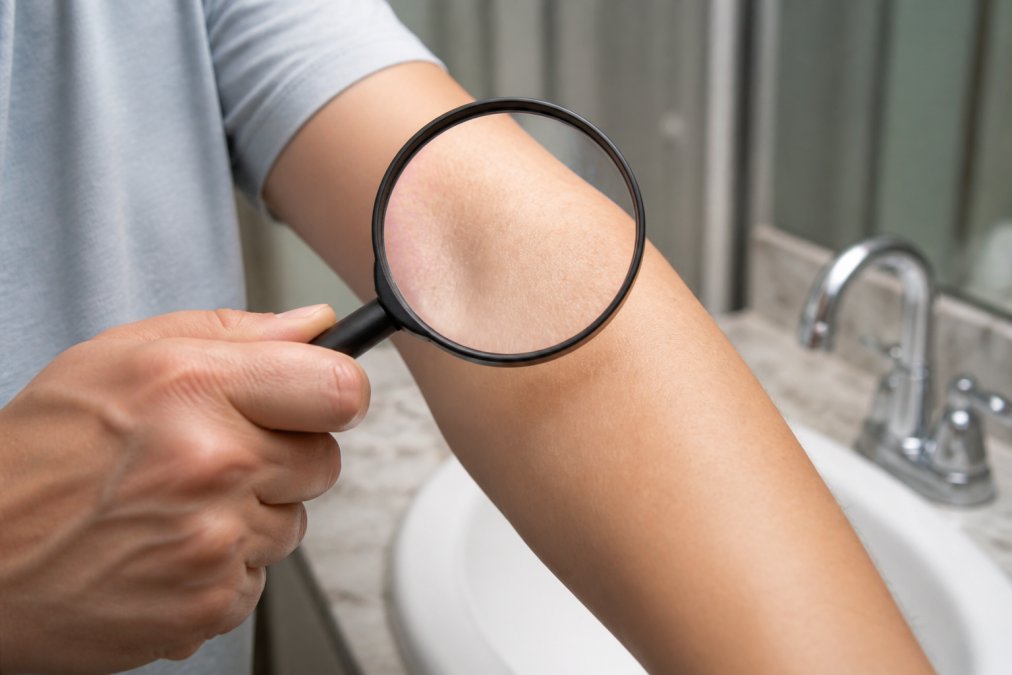
A few practical checks help narrow things down:
- Location matters more than appearance. Burrows cluster in specific spots, not random ones.
- Symmetry is a clue. Finding tracks on both hands or both wrists points toward scabies.
- Timing matters. Itching that gets worse at night is a common pattern.
- Household spread is a red flag. If more than one person in the home is itchy, scabies moves up the list fast.
What a Burrow Actually Looks Like, Step by Step
Real burrows are fainter, smaller, and messier than the clean lines you see online. Here is what you will actually see at each stage.
Dermoscopy vs. Naked Eye
Dermoscopy beats the naked eye for finding burrows, but most people do not have a dermatoscope at home. This small lighted magnifier, pressed against the skin by a clinician, shows a burrow in scabies as a clear, dark, wavy line with a small triangular structure at one end, the "delta wing" sign.
A simple comparison:
| Method | What You See | Best For |
|---|---|---|
| Naked eye | Faint wavy lines, small bumps | First self-check at home |
| Magnifying glass | Clearer track shape, possible dot | Better home inspection |
| Dermatoscope | Delta wing sign, mite at tunnel end | Clinical confirmation |
A Home Visual Checklist You Can Actually Use
To inspect your own skin before seeing a clinician, work through this sequence. It takes about ten minutes and needs only a bright light and a magnifying glass.
- Clean and dry the skin. Do not moisturize first, lotion blurs the surface.
- Find the classic sites. Webbing between fingers, wrist creases, elbow creases, armpits, waistline, buttocks, and the skin around genitals.
- Stretch the skin gently. Tension makes faint tunnels more visible.
- Scan in raking light. Hold the light at a low angle so shadows reveal raised lines.
- Look for the endpoint. A small bump or dot at the end of a line is the strongest single clue.
- Compare both sides. Symmetrical findings raise suspicion.
- Photograph and date. Track whether marks change over 48 to 72 hours.
Common Skin Conditions Mistaken for Scabies Burrows
Eczema, contact dermatitis, and insect bites are the three conditions most often confused with a burrow in scabies. Each can produce lines, bumps, or intense itching that looks similar at a glance, but the mechanisms differ, and that difference shows up on the skin.
- Eczema (atopic dermatitis). An immune-driven inflammation of the skin barrier. It produces dry, scaly, red patches that flare and calm. It does not create tunnels or an endpoint bump. It tends to appear on the inside of elbows and behind the knees, not in finger webbing.
- Contact dermatitis. A localized reaction to something that touched the skin, soap, detergent, metal, plants. The rash follows the shape of contact. It stays in one area and does not spread to household members. No tunnels.
- Insect bites. Saliva from mosquitoes, fleas, or bedbugs triggers a histamine response. Bites often appear in lines of three (sometimes called "breakfast, lunch, dinner") but they are separate punctures, not connected tunnels. They do not have an endpoint bump with a mite inside.
- Folliculitis. Inflammation of hair follicles, usually from bacteria or friction. Small red bumps around hair shafts. Itches, but does not tunnel.
- Scabies burrows. Short, deliberate-looking tracks, often in webbing and folds, with a small bump at one end. They spread to other people in the home. They worsen at night.
Visual Comparison: What You See vs. What It Means
| Condition | What You See | What It Means |
|---|---|---|
| Scabies burrow | Raised wavy line, 2-10 mm, endpoint bump | Live mite tunneling under skin |
| Eczema | Dry, scaly patches, no line | Skin barrier inflammation |
| Contact dermatitis | Rash shaped like the contact area | Localized allergic reaction |
| Insect bites | Scattered bumps, often in threes | Histamine response to saliva |
| Folliculitis | Red bumps around hair follicles | Follicle inflammation |
The One Clue That Separates Scabies From Everything Else
Household spread. If more than one person in the home develops intense itching that worsens at night, scabies moves to the top of the list. Eczema, contact dermatitis, and folliculitis are not contagious, and insect bites do not spread person-to-person the way scabies does.
Scabies Treatment Duration and What to Expect
What typically happens after treatment:
- Days 1-3: Itching may get worse before it gets better.
- Week 1: A second treatment is often applied to catch newly hatched mites.
- Weeks 2-4: Itching slowly fades as the skin heals.
- Beyond 4 weeks: Ongoing itching may need a follow-up check.
The World Health Organization information on scabies notes that scabies is treatable and that household members usually need treatment at the same time to prevent reinfestation.
Distinguishing Active vs. Post-Treatment Burrows
An active burrow in scabies is one where a live mite is still tunneling and laying eggs; a post-treatment burrow is a healed or healing track left after the mite is gone. The two can look almost identical for weeks, which is why so many people treat themselves again and again when they do not need to.
Signs a burrow may still be active:
- New tracks appear after treatment
- The track looks raised and fresh
- Itching is intense and worse at night
- Other household members develop symptoms
Signs a burrow is likely post-treatment:
- No new tracks forming
- Existing marks are fading, not spreading
- Itching is slowly easing
- No new bumps or blisters
Skin Debris Removal and Post-Treatment Care
Skin debris removal is the step most people skip, and it makes the biggest difference in how your skin feels during recovery. After treatment, your skin is left with dead mite material, dried skin, and residue of whatever you applied; clearing it helps skin breathe and heal.
A simple post-treatment routine:
- Wash gently with lukewarm water, not hot
- Use a mild cleanser that does not strip your skin
- Pat dry instead of rubbing
- Moisturize while skin is still slightly damp
- Avoid harsh scrubs for at least two weeks
- Wash bedding and clothing in hot water and dry on high heat
- Vacuum soft surfaces where skin flakes may sit
Conclusion
Figuring out whether a mark on your skin is an active burrow in scabies or just healing skin is genuinely hard, and the wait for your skin to calm down can feel endless. Get Your Life Back LLC makes Nature's Gift® Debriding Soap: a plant-based, hypoallergenic formula that deep cleans pores, removes debris, and supports your skin's natural function without harsh ingredients.
Frequently Asked Questions
What is a burrow in scabies?
A burrow in scabies is a tiny, thread-like tunnel that a female Sarcoptes scabiei mite creates in the top layer of your skin, the stratum corneum. These burrows appear as thin, wavy lines, often grayish or skin-colored, and measure just a few millimeters. The mite lives inside this tunnel, laying eggs that hatch into larvae and nymphs, which can trigger an inflammatory response and intense itching.
How long do scabies burrows last on the skin?
After successful treatment, scabies burrows typically fade within two to four weeks as your skin renews itself. However, itching can persist for up to four weeks after the mites are gone. This is a hypersensitivity reaction to dead mites and waste, not a sign of active infestation. If new burrow tracks appear after treatment, consult a dermatologist for a clinical diagnosis.
What can be mistaken for a scabies burrow?
Several skin issues can mimic burrows, including eczema, contact dermatitis, and even scratch marks from severe itching. Pimple-like irritations, allergic reactions, or bacterial colonization can also create similar-looking lines. A dermatologist can use dermoscopy to distinguish true mite tunnels from other skin debris or inflammatory responses.
What is the best way to clean skin affected by scabies?
Gently wash the affected area with a mild, non-comedogenic cleanser to remove surface debris without irritating the skin. Avoid scrubbing, which can worsen inflammation. For deep-cleaning support, a plant-based debriding soap can be used. After washing, pat dry and apply any prescribed topical treatment. Clean bedding and clothing in hot water to prevent reinfestation.
This article is for general information only and is not a substitute for professional medical advice, diagnosis, or treatment. Always consult a qualified healthcare provider about your skin symptoms.
Share this post
- Tags: burrow in scabies, how to identify scabies burrows, scabies treatment duration, skin debris removal