
7 Best Natural Soaps for Eczema Relief Tested
Posted by Editorial Team on
Quick Summary
The best natural soap for eczema is usually a fragrance-free bar with a short ingredient list, since fragrance, harsh surfactants and preservatives trigger most flares. Patch test any new bar on a small area for several days before using it widely. The Nature's Gift Unscented Bar Soap is a reasonable starting point for natural soap eczema care.
- Choose fragrance-free over unscented, because masking fragrance can hide in unscented products.
- Avoid sodium lauryl sulfate, the most studied irritant surfactant in foaming bars and body washes.
- Patch test on the inner forearm for three to five days before full-body use.
- Apply moisturizer while skin is still slightly damp, and avoid very hot water.
- Soap does not treat eczema; persistent itching, redness or oozing needs a clinician.
Table of Contents
- How Eczema-Prone Skin Reacts to Soap and Cleansers
- Soap Ingredients to Avoid for Eczema
- Best Natural Soap for Eczema Relief: Our Shortlist
- Best Bar Soap for Eczema: Choosing Between Bar and Liquid
- Best Goat Milk Soap for Eczema: What the Evidence Shows
- Best Natural Soap for Eczema Relief on the Face
- Patch Testing and Bathing Habits That Protect Dry Skin
- Start With an Unscented Bar and Test It on One Patch of Skin
- Frequently Asked Questions
How Eczema-Prone Skin Reacts to Soap and Cleansers
Eczema-prone skin has a weakened barrier, so it loses moisture faster and lets irritants in more easily. Choosing a gentler bar matters more than the label on the front.
The practical question is not whether a soap is natural. It is whether the formula leaves the skin feeling comfortable after rinsing, without tightness or stinging. Many people with sensitive skin find that low-residue, oil-based bars are easier to tolerate than foaming gels loaded with surfactants.
Watch out: a soap that feels fine on the forearm can still sting on flared skin, so test before full-body use.
Soap Ingredients to Avoid for Eczema
Most eczema flares linked to cleansing come from a short list of ingredients, but the label rarely makes them obvious. The goal is not to memorize every chemical name. It is to recognize the categories that most often trigger irritation and to know where they hide on a bar or bottle.
Fragrance and essential oils. "Fragrance" or "parfum" on a label can represent dozens of undisclosed compounds, and it is one of the most common causes of allergic contact dermatitis in people with sensitive skin. Essential oils such as tea tree, lavender, peppermint, and citrus are natural but still contain volatile aromatic compounds that can sting flared skin. A product labeled "unscented" is not automatically fragrance-free; some unscented products contain masking fragrance. Look for "fragrance-free" instead.
Harsh surfactants. Sodium lauryl sulfate (SLS) is the most studied irritant surfactant and appears in many foaming bars and body washes. Sodium laureth sulfate (SLES) is generally milder but still a surfactant. For eczema-prone skin, surfactant-heavy formulas can strip lipids from the skin surface faster than the barrier can replace them. A common pattern is that a product feels fine on the first wash and causes tightness or stinging by the third or fourth.
Preservatives and other allergens. Liquid soaps and body washes need preservatives because they contain water. Common ones include methylisothiazolinone (MI), methylchloroisothiazolinone (MCI), and parabens. MI and MCI are well-documented contact allergens and are restricted in some regions for leave-on products (L_2014282EN.01000101.xml). Bar soaps are usually preservative-free because they contain little water, which is one reason some people with eczema tolerate bars better.
Dyes and exfoliants. Added colorants serve no cleansing purpose and add another potential allergen. Ground oatmeal, seeds, or pumice can feel soothing in theory but create micro-abrasions on inflamed skin. Save exfoliation for calm periods, not flares.
How to screen a label in practice. Read the full ingredient list, not the front-of-pack claims. Ingredients are listed in descending order of concentration, so a surfactant near the top is a bigger concern than one near the bottom. If you want to check whether a specific bar suits eczema-prone skin, read how bio form carbon soap works and whether it is safe for eczema. Short lists are easier to audit, but short does not automatically mean gentle. If a product claims "hypoallergenic" or "dermatologist-tested," treat those as marketing terms rather than guarantees; there is no standardized definition for either in most markets.
Watch out: a soap that feels fine on the forearm can still sting on flared skin, so patch test any new bar on a small area before full-body use.
Best Natural Soap for Eczema Relief: Our Shortlist
The Nature's Gift soaps available from Get Your Life Back LLC include fragrance-free and lightly scented options built on saponified plant oils.
Nature's Gift Unscented Bar Soap
It is built from saponified safflower, olive, castor, palm, and coconut oils, with no added fragrance in the listed ingredients. At $10.95 for a 4.5 oz bar, it is priced the same as the rest of the bar range.
Nature's Gift Tea Tree Oil Soap
This bar adds tea tree oil to the same saponified oil base. The added essential oil is the main variable, so patch test first.
The two Nature's Gift soaps in this shortlist differ mainly in their added ingredients and price: compare the Nature's Gift Unscented Bar Soap ingredients and usage directions alongside the tea tree version.
| Product | Key difference |
|---|---|
| Nature's Gift Unscented Bar Soap | No added fragrance in listed ingredients |
| Nature's Gift Tea Tree Oil Soap | Adds tea tree oil to the same oil base |
Best Bar Soap for Eczema: Choosing Between Bar and Liquid
The bar-versus-liquid question matters for eczema-prone skin because the two formats are formulated differently, not just packaged differently. Understanding the trade-offs helps you choose based on your skin rather than on marketing.
Why bars often suit eczema-prone skin. Traditional bar soap is made by saponifying fats and oils with an alkali, which produces a solid product with very low water content. Low water means no preservatives are needed, and the ingredient list is usually shorter. Many bars also contain glycerin, a humectant that remains after saponification and helps the bar feel less drying. The trade-off is that true soap has a naturally alkaline pH, typically around 9 to 10, while healthy skin sits closer to pH 5. For some people with eczema, that pH shift can feel irritating; for others, the simpler formula outweighs it.
Why liquid cleansers are different. Liquid body washes and shower gels are water-based, so they require preservatives and often more surfactants to create foam. Many are formulated as syndets (synthetic detergents) rather than true soap, which lets manufacturers control pH closer to skin's natural range. A well-formulated, fragrance-free syndet can be gentler than an alkaline bar for some eczema-prone skin, especially on the face. The trade-off is a longer ingredient list and more potential allergens.
How to compare without guessing. Look at the first three to five ingredients. In a bar, you want to see saponified oils (such as sodium olivate or sodium cocoate) and glycerin. In a liquid, look for mild surfactants such as coco-glucoside or sodium cocoyl isethionate rather than SLS near the top. Check for "fragrance-free" rather than "unscented." If a product lists MI or MCI, consider it a higher-risk choice for sensitive skin.
Matching format to skin needs. For routine body cleansing during calm periods, a fragrance-free bar with a short list is a reasonable default. For facial cleansing or for skin that stings even with mild bars, a fragrance-free syndet liquid may be easier to tolerate. For flare periods, many practitioners suggest minimizing cleanser altogether and using only lukewarm water on affected areas, then moisturizing immediately.
What neither format does. No soap treats eczema. Cleansing removes irritants and oils; it does not repair the barrier or reduce inflammation. If itching, redness, or oozing persists despite gentle cleansing and moisturizing, that is a signal to see a clinician rather than to switch products again.
Watch out: a liquid labeled "gentle" or "for sensitive skin" can still contain fragrance or MI, so read the full ingredient list rather than the front label.
Best Goat Milk Soap for Eczema: What the Evidence Shows
Goat milk soaps are widely promoted for sensitive skin, but the evidence for eczema-specific benefit is limited. Goat milk contributes fats and proteins that may feel nourishing, yet the research behind eczema relief is thin. Treat goat milk as a comfort feature rather than a treatment.
Our listed products do not include goat milk, so use this section as a framework when reading other labels.
Best Natural Soap for Eczema Relief on the Face
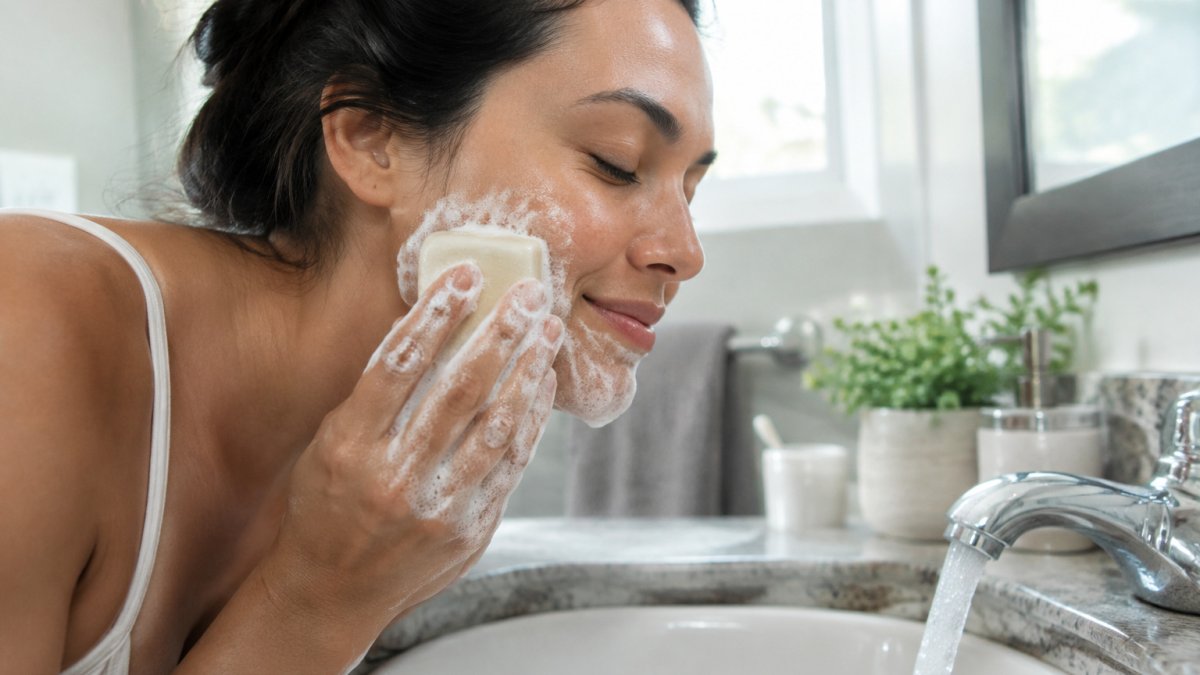
The face has thinner skin than the body, so a cleanser that feels fine on the arms can still irritate it. Use a gentle, fragrance-free bar, lather it in your hands first, and rinse with lukewarm water. Pat dry rather than rubbing.
Close-up of a person gently washing their face with a bar of soap at a bathroom sink in soft morning light.
Patch Testing and Bathing Habits That Protect Dry Skin
Patch test any new soap on a small area, such as the inner forearm, for several days before using it widely. Shorter, lukewarm showers and moisturizing immediately after bathing do more for dry skin than switching products alone.
Apply moisturizer while the skin is still slightly damp to lock in hydration. Avoid very hot water, which strips oils quickly.
Start With an Unscented Bar and Test It on One Patch of Skin
If you are new to natural soaps for eczema, start with the Nature's Gift Unscented Bar Soap. Use it on one small area for three to five days, watch for stinging, redness, or itching, and only expand use if your skin stays calm. This simple test prevents most avoidable flares.

Frequently Asked Questions
What is the best all-natural soap for eczema?
No single soap suits every case, but the most useful starting point is a fragrance-free, unscented bar made from simple saponified oils. Nature's Gift Unscented Bar Soap, priced at 10.95 for a 4.5 oz bar, is built on safflower, olive, castor, palm and coconut oils. Because eczema-prone skin reacts individually, test any new soap on a small area first and stop using it if redness, stinging or itching increases.
What soap ingredients should people with eczema avoid?
Fragrance and essential oils are the most common triggers, so start by checking labels for added fragrance and strong botanical oils. Harsh detergent-style surfactants and high-alkaline soaps can strip the skin barrier and worsen dryness. Products made with sulfur or tea tree oil can also irritate some people, so introduce them slowly if you choose them. Reading the full ingredient list is more reliable than trusting words like natural or gentle on the front label.
Are fragrance-free soaps better for eczema?
For most people with eczema-prone skin, fragrance-free products are the safer choice because fragrance is a frequent cause of irritation and contact sensitivity. Unscented formulas reduce the number of possible triggers, which makes it easier to identify what causes a flare. Fragrance-free does not automatically mean hypoallergenic, so still check the full ingredient list and patch test before using a new product on larger areas of skin.
Is goat milk soap suitable for eczema-prone skin?
Goat milk soap is popular for dry skin, but the evidence that it specifically relieves eczema is limited. Many goat milk soaps still contain fragrance or essential oils, which can irritate sensitive skin. If you want to try one, choose a version with a short, simple ingredient list and patch test it first. Ask a dermatologist before relying on any soap as part of eczema management, especially if your symptoms are severe or spreading.

Share this post
- Tags: best bar soap for eczema, best goat milk soap for eczema, best natural soap for eczema relief, best natural soap for eczema relief for face, natural soap eczema, soap ingredients to avoid for eczema