

Fragrance Free Cleanser for Shingles: Safe Washing Guide
Publicado por Editorial Team en
Table of Contents
- Why a Fragrance Free Cleanser Matters for Shingles Skin
- How to Wash a Shingles Rash: A Step-by-Step Routine
- What to Avoid on a Shingles Rash
- How to Care for Shingles Blisters After Washing
- How to Read a Fragrance Free Cleanser Label
- Choosing a Cleanser by Outbreak Stage and Skin Condition
- When Cleansing Is Not Enough: Seeking Medical Help
- Conclusion
- Frequently Asked Questions
Last Updated: October 17, 2026
Why a Fragrance Free Cleanser Matters for Shingles Skin
A fragrance free cleanser for shingles is a wash with no added scent and no harsh detergents, made to clean irritated skin without triggering more burning or itching. At Get Your Life Back LLC, the cleanser is usually the first thing to fix. Shingles already leaves skin raw, blistered, and hyper-sensitive. The wrong soap makes that worse within minutes.
How Shingles Changes Skin Sensitivity
Shingles follows a nerve path. The rash appears in a band or strip, usually on one side of the body. The skin over that nerve becomes tender, and even light touch can sting.
Your normal body wash may suddenly feel like sandpaper. Skin that tolerated a scented soap last month may now burn, tingle, or itch for hours after a shower.
What Fragrance and Harsh Ingredients Do to Irritated Skin
Fragrance is the most common cause of allergic contact dermatitis in personal care products, according to the American Academy of Dermatology's guidance on fragrance allergies. On broken or blistered skin, the reaction can be faster and stronger.
Synthetic fragrance, essential oils, and strong foaming agents all strip the skin's outer layer, which the rash has already damaged. Strip it further and you get dryness, cracking, and a higher chance of infection.
How to Wash a Shingles Rash: A Step-by-Step Routine
Wash a shingles rash with lukewarm water and a small amount of fragrance free cleanser, using your hands instead of a cloth, then rinse gently and pat dry. Keep the whole routine under ten minutes.
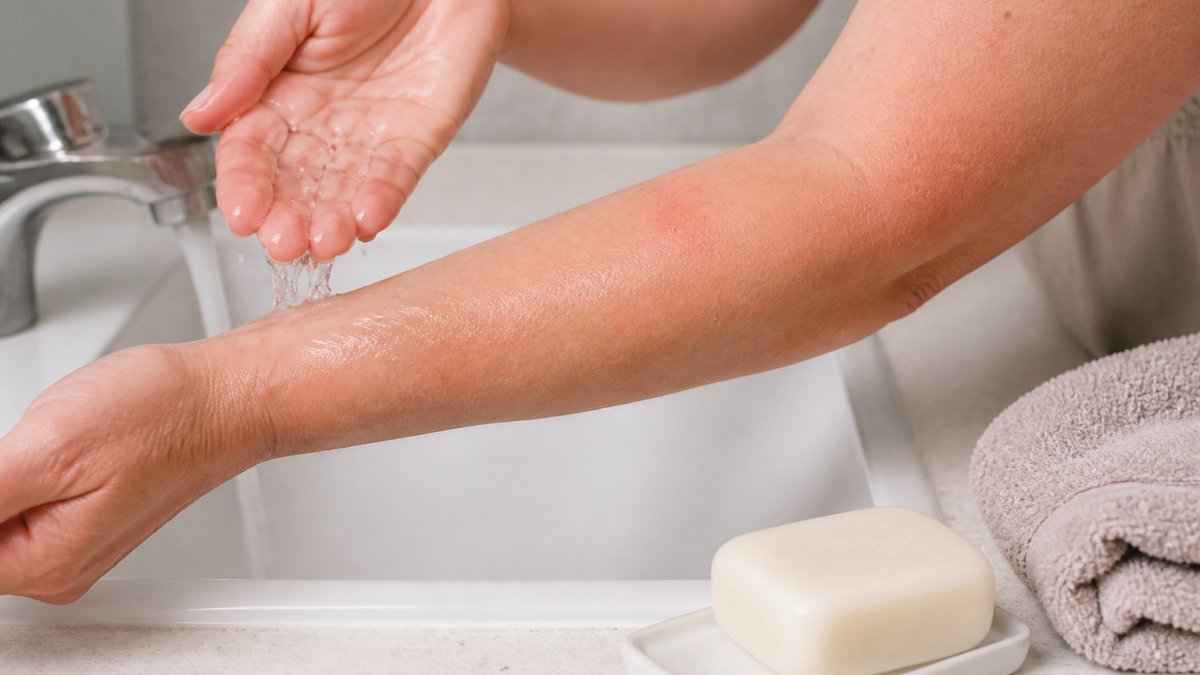
Here is the routine we recommend:
- Set the water to lukewarm. Hot water increases blood flow and makes itching worse.
- Wet the skin gently. Let water run over the rash. Do not rub.
- Apply a small amount of cleanser. A pea-sized amount is enough for a small area.
- Use your fingertips only. No washcloths, loofahs, or sponges, which can carry bacteria.
- Skip the scrub. Never rub, pick, or exfoliate the rash.
- Rinse thoroughly. Leftover cleanser dries the skin and causes itching.
- Pat dry with a clean towel. Use a separate towel from other household members.
- Wash your hands afterward. This protects both you and anyone helping you.
A Practical Bathing Routine During an Active Outbreak
Shower once a day while the rash is active. More frequent washing dries the skin. If you sweat heavily or the area gets dirty, a second quick rinse with water alone is fine.
Keep the bathroom warm but not steamy, and dress in loose cotton clothing right after drying so the skin can breathe.
What to Avoid on a Shingles Rash
Avoid anything scented, anything that foams heavily, and anything that scrubs: perfumed soap, essential oils, bath bombs, exfoliating scrubs, and hot water. Each adds irritation on top of an already inflamed nerve.
Also avoid these common mistakes:
- Antibacterial hand soap on the rash. It is far too harsh for broken skin.
- Sharing towels or washcloths. The virus lives in blister fluid.
- Covering the rash with tight clothing. Friction makes it worse.
If a product lists "fragrance," "parfum," or "essential oil blend" on the label, keep it off the rash.
How to Care for Shingles Blisters After Washing
Care for shingles blisters by leaving them intact, keeping them clean and dry, and covering them loosely if they might rub against clothing. Do not pop them.
After washing, pat the area dry and let it air for a few minutes.
Once blisters crust over, they still need gentle care. Keep using the fragrance free cleanser and avoid picking at scabs, which can scar and reopen the skin to infection.
How to Read a Fragrance Free Cleanser Label
A truly fragrance free cleanser lists no fragrance, parfum, or essential oils, and it should say "fragrance-free" rather than "unscented." Those two words are not the same: unscented products may contain a masking fragrance to cover the smell of raw ingredients.
Fragrance-Free vs. Unscented vs. No Added Fragrance
These three phrases sound interchangeable but are not regulated the same way in every market. "Fragrance-free" generally means no scent has been added and no masking fragrance is present.
Products labeled unscented often still contain a small amount of fragrance to neutralize the smell of the base formula, and for shingles skin that small amount is still exposure. When in doubt, treat "unscented" as a check-carefully term and "fragrance-free" as the safer default.
Nature's Gift Unscented Bar Soap ( 4.5 oz each ) →
The Ingredient Terms That Matter Most
Scan the ingredient list for these terms, which appear in roughly the order of concentration (highest first in most markets):
| Label term | What it means | Safe for shingles skin? |
|---|---|---|
| Fragrance-free | No scent added, no masking scent | Usually yes |
| Unscented | May contain masking fragrance | Check carefully |
| Parfum / fragrance | Fragrance, often synthetic | Avoid |
| Essential oils (lavender, citrus, peppermint, tea tree, eucalyptus) | Plant oils, still common irritants and allergens | Avoid during outbreak |
| Soap-free | Made with gentler cleansing agents (syndets) | Often a good choice |
| Hypoallergenic | Fewer known allergens, not zero | Helpful, not a guarantee |
| Non-comedogenic | Less likely to clog pores | Helpful for facial or fold areas |
| Lanolin, propylene glycol, methylisothiazolinone | Known contact allergens in some people | Patch test or avoid if reactive |
Two mechanisms explain why these terms matter on shingles skin. Irritant contact dermatitis is a direct chemical injury to the skin barrier, strong foaming agents, high-pH soaps, and alcohol strip lipids and leave skin tight and cracked. Allergic contact dermatitis is an immune reaction that can develop or worsen with repeated exposure, with fragrance mixes, essential oils, and preservatives as common culprits.
How to Scan a Label in Practice
- Read the front claim first. Look for "fragrance-free," not just "gentle" or "sensitive."
- Flip to the ingredient list. Find the word fragrance, parfum, or aroma. If present, put it back.
- Scan for essential oils. Botanical names like Lavandula angustifolia or Citrus limon count as fragrance even when the front label says natural.
- Check the cleansing base. Soap-free syndets (often listed as cocamidopropyl betaine, sodium cocoyl isethionate, or glucosides) tend to be gentler than traditional soap (sodium tallowate, sodium palmate).
- Count the ingredients. A shorter list means fewer chances of a reaction, though short is not automatically safe.
- Patch test. Apply a small amount to normal skin on the inner forearm, well away from the rash, and wait 24 to 48 hours before using it on affected skin.
If a product lists "fragrance," "parfum," or "essential oil blend" on the label, keep it off the rash. When a label is ambiguous, choose the shorter, plainer formula.
Choosing a Cleanser by Outbreak Stage and Skin Condition
Match the cleanser to what your skin is doing right now: early blisters need the gentlest option, crusted or healing skin can handle a little more cleansing, and dry, flaky skin after the rash fades needs moisture more than washing. The table below is a decision guide, not a prescription, your doctor's advice comes first.
| Outbreak stage | What the skin is doing | Cleanser priority | What to avoid |
|---|---|---|---|
| Early (blisters forming) | Raw, weeping, highly sensitive | Fragrance-free, soap-free liquid or bar; fingertips only; lukewarm water | Anything foaming heavily, cloths, scrubs, essential oils |
| Active (blisters present) | Open, fragile, risk of bacterial infection | Same gentle cleanser; pat dry; separate towel | Sharing towels, picking, tight clothing, scented laundry residue |
| Crusting | Drying, itchy, scabs forming | Gentle cleanser plus a fragrance-free moisturizer after patting dry | Picking scabs, exfoliating, hot water |
| Healing / post-rash | Dry, flaky, sometimes sensitive | Mild cleanser less often; prioritize moisturizing | Over-washing, returning immediately to old scented products |
Matching the Formula to Your Skin Type
- Very sensitive or allergy-prone skin: choose a bar or liquid with a short ingredient list and no scent. Patch test first.
- Dry or tight-feeling skin: a soap-free wash is a good pick if your skin feels tight after showering; follow with a fragrance-free moisturizer while skin is still slightly damp.
- Oily or debris-prone skin (including skin folds): a gentle, non-comedogenic cleanser helps without stripping; avoid anything labeled deep-cleansing or exfoliating during the outbreak.
When to Stop Using a Product
Stop a cleanser and contact a clinician if you notice:
- New or spreading redness, swelling, or warmth after use
- Increased stinging, burning, or itching that lasts more than a short time after rinsing
- Pus, weeping, or a foul odor from the rash
A product that worked last month may not work during an outbreak because the skin barrier is compromised. Re-evaluate rather than push through.
This is where our Nature's Gift Unscented Bar Soap fits. It is made with plant-based oils and our Nature's Gift concentrate, with no added fragrance.

We built our formula around the request for a cleanser that cleans effectively without harsh chemicals.
When Cleansing Is Not Enough: Seeking Medical Help
Cleansing manages the surface of the skin. It does not treat the virus. Shingles needs medical care, and antiviral treatment works best when started early.
Contact a doctor promptly if you notice:
- The rash is near your eye, ear, or nose
- You have fever, severe pain, or feel generally unwell
- Blisters look infected: spreading redness, pus, or increasing heat
The CDC's overview of shingles symptoms and complications notes that antiviral medicine can shorten the illness and reduce complications when started soon after the rash appears. Do not wait to see whether it settles on its own.
Natural remedies have their place for comfort, but the evidence for most of them is limited. The NHS guidance on treating shingles makes the same point: see a doctor quickly, especially if the rash is near the eye.
Conclusion
Managing shingles skin is a balance: keep the area clean without adding irritation, and get medical care alongside home care. A fragrance free cleanser handles the cleaning part well, but it cannot do the job of antiviral medicine.
At Get Your Life Back LLC, we make gentle cleansing simpler. Our Nature's Gift Unscented Bar Soap uses plant-based ingredients, a short ingredient list, and no added fragrance.
Frequently Asked Questions
Can I use a fragrance-free cleanser on shingles?
Yes, a fragrance free cleanser is generally the safer choice for shingles-affected skin because it avoids added perfumes that can trigger irritation. Look for a mild, soap-free or low-ingredient formula, patch test on unaffected skin first, and keep the wash brief with lukewarm water. Cleansing removes debris and keeps the area clean, but it does not treat the virus itself, so pair it with medical advice from your doctor.
What ingredients should I avoid in a cleanser when I have shingles?
Skip synthetic fragrance, essential oils, salicylates, alcohol-heavy formulas, and strong exfoliants while the rash is active. These are known irritants that can worsen skin sensitivity and dryness. Check labels for parfum, menthol, and added dyes. A short ingredient list with plant-based oils and no added scent is easier to tolerate, and it helps you avoid irritants without guessing which compound caused a reaction.
Should I use soap on a shingles rash?
A gentle, unscented soap or soap-free cleanser is fine for brief washing, but harsh bar soaps and scented body wash should stay off the rash. Wet the skin, apply the cleanser, leave it for a short time, then rinse with lukewarm water and pat dry. Never scrub blisters. If the skin stings or tightens after washing, switch to a milder fragrance free cleanser and ask a pharmacist or doctor for guidance.
How do I dry shingles blisters after washing?
Pat the area dry with a clean, soft towel instead of rubbing, and let the skin air dry fully before applying any non-prescription ointment. Do not pop blisters or pick at crusts, since that raises the risk of infection and scarring. Keep the towel separate from other laundry, wash it hot after each use, and contact a healthcare professional if a blister oozes pus, spreads, or comes with fever.
Compartir esta publicación
- Etiquetas: fragrance free cleanser, fragrance free cleanser for shingles, how to care for shingles blisters, how to wash a shingles rash, what to avoid on shingles rash