

What Causes Chronic Skin Inflammation? A Clear Guide
Posted by Editorial Team on
Last Updated: October 26, 2026
Quick Summary
Chronic skin inflammation is a persistent immune response driven by three interacting factors: a damaged skin barrier, an overactive immune system, and genetic predisposition. Barrier disruption lets triggers in, immune cells respond, and that response further damages the barrier, creating a self-perpetuating loop.
- Eczema triggers are environmental inputs, while causes are genetics and barrier function.
- Filaggrin gene variants are a cause you cannot change; scented soaps are a trigger you can remove.
- Stacking small exposures like a hot shower, scented detergent, and stress can produce a flare.
- Gentle cleansing means avoiding fragrance, harsh surfactants, and anything leaving skin tight.
- Red flags for prompt medical review include rapidly spreading redness, fever, or pus.
Table of Contents
- What Causes Chronic Skin Inflammation? The Root Mechanisms
- Atopic Dermatitis Causes: Genetics, Barrier Defects, and Immune Overdrive
- Eczema Triggers vs. Causes: What Actually Sets Off a Flare
- Contact Dermatitis Causes: Irritants, Allergens, and Occupational Exposures
- Psoriasis and Seborrheic Dermatitis: When the Immune System Attacks the Skin
- How to Tell Similar-Looking Conditions Apart: A Stepwise Diagnostic Guide
- Skin Inflammation Treatment: From Trigger Avoidance to Targeted Care
- Choosing a Gentle Daily Cleanser for Reactive Skin
- Frequently Asked Questions
What Causes Chronic Skin Inflammation? The Root Mechanisms
Chronic skin inflammation is a persistent immune response in the skin that lasts weeks, months, or years, driven by an overactive immune system, a damaged skin barrier, and genetic predisposition rather than by a single irritant. At Get Your Life Back LLC, we explain it as a loop: barrier disruption lets triggers in, immune cells respond, and the response itself further damages the barrier. That loop is what separates chronic skin inflammation from a temporary rash.
The mechanism has three moving parts. First, epidermal barrier disruption: when the outer layer loses lipids and moisture, allergens and bacteria slip through gaps. Second, immune dysregulation: inflammatory mediators such as histamine and cytokines stay switched on longer than they should. Third, blood vessel dilation and fluid accumulation, which produce the visible redness, itching, and swelling.
Most guides treat these as separate problems. They aren't. Fixing one without the others rarely holds, which is why flare-ups return. For a broader look at day-to-day management, our guide to managing chronic skin flares covers the full picture.
Atopic Dermatitis Causes: Genetics, Barrier Defects, and Immune Overdrive
Atopic dermatitis causes trace to three overlapping factors: inherited filaggrin and barrier-protein defects, a hyperreactive immune system skewed toward allergic response, and environmental exposures that exploit both. No single gene causes it, and no single trigger explains every flare.
The genetics matter more than most people expect. A family history of eczema, asthma, or hay fever raises risk substantially, and many patients carry variants that leave the skin structurally weaker from birth. That weakness is why dry skin, skin sensitivity, and itching cluster together in the same person.
Immune overdrive compounds it. In atopic skin, inflammatory mediators release in response to stimuli that would barely register on healthy skin. A common mistake is treating the itch as the disease; the itch is a symptom of an immune response already underway.
Eczema Triggers vs. Causes: What Actually Sets Off a Flare
Eczema triggers are not the same as causes, and confusing the two is the single most common reason trigger-avoidance strategies fail. A cause is the underlying predisposition, meaning genetics and barrier function. A trigger is an environmental input that provokes a flare in skin already primed to react.
Causes: the underlying susceptibility. The root causes of chronic skin inflammation are a combination of genetic predisposition (including filaggrin gene variants and other barrier-protein defects), immune dysregulation skewed toward allergic response, and a skin barrier that is structurally weaker from birth. These are not removable.
Triggers: the inputs that provoke a flare. Triggers commonly include soaps and detergents, perfumes and fragrance mixes, wool and synthetic fabrics, temperature swings, low humidity, stress, and hormonal changes. Environmental triggers such as pollution and UV radiation add load. Bacterial colonization, especially staphylococcus aureus, worsens barrier function and drives infection risk.
How causes and triggers interact. Many people find that stacking several small exposures, a hot shower plus a scented detergent plus a stressful week, produces a flare that none of those would cause alone.
Evidence grading: what is well-supported versus uncertain. Barrier repair and trigger avoidance have strong support. Common triggers such as fragrance, harsh surfactants, and low humidity are well-established. Stress is widely reported by patients and supported by physiological evidence, but the effect size varies. Dietary claims, including elimination diets and supplements, have weak or mixed evidence and should be treated as supportive rather than curative.
| Factor | Type | What You Can Change | Evidence Strength |
|---|---|---|---|
| Filaggrin gene variants | Cause | Nothing | Strong |
| Impaired barrier function | Cause | Partly, via consistent care | Strong |
| Scented soaps and perfumes | Trigger | Yes, remove them | Strong |
| Low humidity | Trigger | Yes, humidify | Moderate |
| Stress | Trigger | Partly, manage it | Moderate |
| Bacterial overgrowth | Trigger/complication | Yes, with cleansing and care | Moderate |
| Specific diets | Uncertain trigger | Yes, but evidence limited | Weak/mixed |
For a broader look at day-to-day management, our guide to managing chronic skin flares covers the full picture.
Contact Dermatitis Causes: Irritants, Allergens, and Occupational Exposures
Contact dermatitis causes split into two categories: irritant contact dermatitis, a direct chemical injury to the skin, and allergic contact dermatitis, a delayed immune reaction to a specific allergen. The distinction decides your strategy, because irritant reactions improve when exposure stops, while allergic reactions require identifying and avoiding the exact substance.
Irritants include detergents, solvents, acids, and repeated water exposure. Common allergens include nickel, fragrance mixes, preservatives, and rubber accelerators. Occupational exposures deserve special attention: hairdressers, cleaners, healthcare workers, mechanics, and food handlers face daily contact with both categories, often on the hands first.
Medication and product exposures are frequently missed. Topical treatments, adhesives, and even "gentle" cosmetics can carry allergens. If a rash appears only where a product touches skin and clears when you stop, that pattern points toward contact dermatitis rather than an internal cause.
Psoriasis and Seborrheic Dermatitis: When the Immune System Attacks the Skin
Psoriasis and seborrheic dermatitis both involve immune-driven inflammation, but they behave differently. Psoriasis is an autoimmune-related condition in which immune signalling accelerates skin cell turnover, producing thick, silvery scales on plaques, typically on elbows, knees, and scalp. Seborrheic dermatitis targets oil-rich areas such as the scalp, eyebrows, and nasolabial folds, producing greasy yellowish flaking.
Neither is caused by poor hygiene. That myth causes real harm, because people scrub harder, irritate the barrier, and worsen the flare. Seborrheic dermatitis is linked to Malassezia yeast and sebum, plus stress and cold weather. Psoriasis is linked to genetic predisposition and immune dysregulation, and it can be triggered by infection, stress, and certain medications.
Both conditions can coexist with eczema, and both benefit from gentle cleansing rather than aggressive exfoliation.
Organic Dandelion Root Tea 3.5oz →
How to Tell Similar-Looking Conditions Apart: A Stepwise Diagnostic Guide
Similar-looking conditions are separated by pattern, location, timing, and response to treatment, not by appearance alone. A stepwise process narrows the field before any prescription is considered.
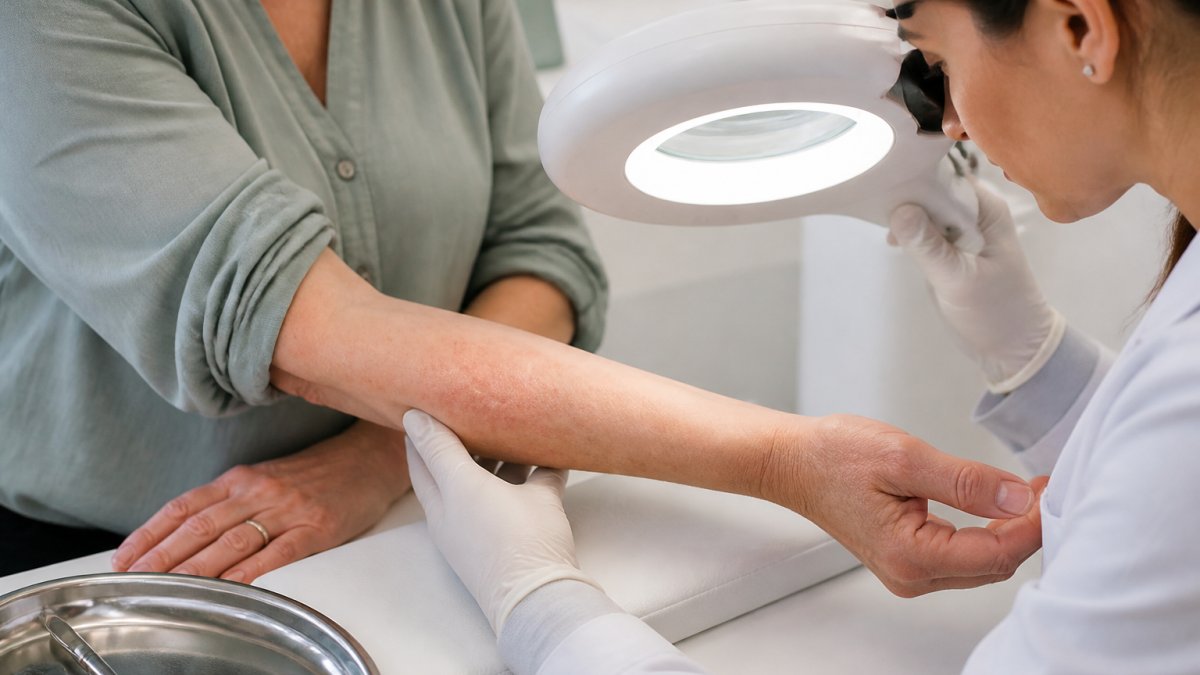
Step 1: History before examination. A clinician first asks about onset, duration, pattern of flares, family history of atopy or psoriasis, occupational exposures, and all products and medications used.
Step 3: Note the morphology. Weeping and crusting point to eczema; silvery scale on plaques to psoriasis; greasy yellow flakes to seborrheic dermatitis; well-demarcated erythema with vesicles to contact dermatitis.
Step 4: Establish the timeline. Acute inflammation appears suddenly and often resolves with removal of the trigger; chronic inflammation persists for weeks or months with skin thickening.
Step 5: Audit exposures. List every product, medication, and workplace chemical touching the area. This includes topical treatments, adhesives, cosmetics, soaps, and gloves.
Step 6: Test the response. Removal of a suspected irritant or allergen is itself diagnostic. If the rash clears when the product is stopped and returns when it is reintroduced, that pattern strongly supports contact dermatitis.
Step 7: Escalate for confirmation when needed. Patch testing is the standard for identifying allergic contact dermatitis and is especially useful when the culprit is not obvious.
This stepwise approach is not a substitute for clinical judgment. It is a framework for understanding why a clinician asks certain questions and orders certain tests, and it helps patients prepare for a more productive consultation.
Skin Inflammation Treatment: From Trigger Avoidance to Targeted Care
Skin inflammation treatment works in layers, starting with trigger avoidance and barrier repair, then moving to targeted medication for persistent disease. Lifestyle measures alone rarely resolve moderate-to-severe chronic inflammation, and medication alone fails if the barrier stays damaged.
Start with the basics: lukewarm showers, a fragrance-free moisturizer applied within minutes of washing, soft fabrics, and humidified air. These steps reduce trigger load and support barrier function. If flares persist, topical corticosteroids or calcineurin inhibitors reduce inflammatory mediators directly. For moderate-to-severe atopic dermatitis or psoriasis, clinicians may consider systemic or biologic therapy.
Evidence grading matters here. Barrier repair and trigger avoidance have strong support. Many lifestyle claims, including specific diets, have weak or mixed evidence, so treat them as supportive rather than curative. For a deeper comparison of medical routes, see our breakdown of chronic skin disease treatment options and whether chronic skin conditions can be resolved with medications.
Choosing a Gentle Daily Cleanser for Reactive Skin
A gentle daily cleanser should clean without stripping lipids, and for reactive skin that means avoiding fragrance, harsh surfactants, and anything that leaves skin tight afterward. Cleansing is where many people accidentally feed the inflammation loop.
Look for short ingredient lists, non-comedogenic formulas, and hypoallergenic claims you can verify. Avoid perfumes, drying alcohols, and aggressive exfoliating acids during a flare. If your skin stings within a minute of washing, the product is too harsh regardless of what the label says.
At Get Your Life Back LLC, our Nature's Gift® Debriding Soap uses a proprietary liquid bio-form carbon technology with a particle size of 6 angstroms, formulated to deep-clean and remove debris from pores while remaining non-comedogenic and hypoallergenic. It pairs well with our natural approaches to soothing irritated skin at home and our look at whether bio form carbon soap helps eczema. We also offer Nature's Gift® Digestive Aid & Skin Regenerator capsules at $59.95, containing polyphenols intended to support digestion and the deeper layers of the skin.
Frequently Asked Questions
Can inflammation in the body cause skin problems?
Yes. Chronic skin inflammation often reflects systemic immune dysregulation, not just a surface issue. Inflammatory mediators released inside the body can show up as redness, itching, and flaking on the skin. Conditions like psoriasis are linked to broader inflammatory pathways, which is why some people notice skin flare-ups alongside joint pain or digestive issues. Treating only the visible rash without addressing underlying triggers often leads to recurring problems.
What are the most common causes of chronic skin inflammation?
The main drivers are genetic predisposition, a weakened skin barrier, immune dysregulation, and repeated exposure to irritants or allergens. Eczema triggers like harsh soaps, fragrances, and stress can worsen the cycle. Contact dermatitis causes include metals, preservatives, and occupational chemicals. Infections and clogged pores can also sustain inflammation. Identifying which combination applies to you is the first step toward effective skin inflammation treatment.
When should I see a doctor about a persistent rash?
See a doctor if a rash lasts more than two weeks, spreads quickly, oozes, bleeds, or comes with fever. Red flags include skin lesions that change shape or color, severe swelling, and symptoms that interfere with sleep or daily life. A stepwise diagnostic process may include patch testing, skin scrapings, or a biopsy. Early evaluation helps rule out infection and narrows down whether atopic dermatitis causes or contact dermatitis causes are at play.
How is the cause of chronic skin inflammation diagnosed?
Diagnosis starts with a detailed history of exposures, products, and flare patterns, followed by a physical exam. Patch testing identifies contact dermatitis causes, while blood tests and skin scrapings help rule out infection or immune conditions. For eczema triggers, keeping a symptom diary is often useful. A dermatologist may also check for genetic predisposition or barrier dysfunction. The goal is to separate root causes from triggers so treatment targets the right mechanism.
Chronic skin inflammation rarely resolves on its own, and guessing at triggers wastes months. Get Your Life Back LLC builds plant-based, hypoallergenic skincare around deep-cleaning bio-form carbon technology, non-comedogenic formulas, and hydration that supports normal skin function. Start with a cleanser that respects your barrier instead of fighting it. Get started with Get Your Life Back LLC and give reactive skin the gentle, thorough clean it has been missing.

Share this post
- Tags: atopic dermatitis causes, chronic skin inflammation, contact dermatitis causes, eczema triggers, skin inflammation treatment, what causes chronic skin inflammation