
Is Plant-Based Soap Good for Eczema? A Review
Publicado por Editorial Team en
Last Updated: November 5, 2026
Quick Summary
Plant-based soap is not automatically good for eczema, because plant-based describes where ingredients come from rather than how gentle they are. Fragrance, essential oils, harsh surfactants, and preservatives can still trigger flares, so check the full ingredient list before buying a plant-based soap.
- Check the full ingredient list, since fragrance and essential oils can irritate even plant-based products.
- Traditional soap is alkaline, which can disturb skin's natural acid mantle and worsen dryness.
- Choose unscented options and introduce any new cleanser one at a time to identify triggers.
- Patch test a new product on the inner forearm once daily for several days before full use.
- Stop using a product and consult a dermatologist if a flare starts or symptoms persist.
Table of Contents
- Whether Soap Is Suitable for Eczema-Prone Skin
- Soap Ingredients That Trigger Eczema and What to Avoid
- Fragrance-Free Cleanser for Eczema: Unscented Versus Scented
- Best Soap for Atopic Dermatitis: Bar Soap Versus Liquid Cleanser
- Plant-Based Soap for Eczema on the Face
- Patch Testing Our Soaps and What to Do If a Flare Starts
- Choosing a Gentle Cleanser for Your Routine
- Frequently Asked Questions
Get Your Life Back LLC has spent years helping people with stubborn skin irritation sort through cleansers, and the first question we hear is usually the same: is a plant-based soap good for eczema? The honest answer is that "plant-based" describes where ingredients come from, not how gentle a product will be on inflamed skin. A soap can be built entirely from plant oils and still contain fragrance, botanical extracts, or preservatives that trigger flares. The label tells you the origin of the ingredients, not whether your skin will tolerate them.
Plant-based marketing has a powerful pull. Words like "natural," "botanical," and "organic" suggest mildness, and many people with eczema assume anything without synthetic chemicals must be safer. That assumption deserves a closer look before you spend money on a product.
Most people with atopic dermatitis have a weakened skin barrier. When that barrier is compromised, irritants and allergens penetrate more easily, regardless of whether they came from a lab or a plant. Essential oils are a common example. They are natural, yet they are also a frequent source of contact irritation for sensitive skin.
Watch out: a "fragrance-free" label does not always mean "scent-free." Some products add masking ingredients or essential oils while still advertising a clean profile, so read the full ingredient list rather than the front of the bottle.
Whether Soap Is Suitable for Eczema-Prone Skin
Soap is not automatically a poor choice for eczema, but many traditional soaps are alkaline enough to disturb the skin's natural acid mantle. That disruption can leave dry skin feeling tight and itchy, which makes a flare more likely. A gentler cleanser, whether a soap-free wash or a mild bar, is usually the safer starting point.
The practical test is how your skin feels afterward. If skin feels squeaky clean, stripped, or tight within minutes, the product is likely too harsh for an eczema-prone routine, whatever its ingredients are called.
Soap Ingredients That Trigger Eczema and What to Avoid
Most eczema flares linked to cleansers come down to a short list of ingredient families, and knowing how each one behaves on a compromised skin barrier is more useful than memorizing a single "bad" list. The categories below are the ones most practitioners flag first.
Fragrance and essential oils. Fragrance is the most common cause of allergic contact dermatitis in cosmetics, and "natural" fragrance is not exempt. Essential oils such as tea tree, lavender, peppermint, eucalyptus, and citrus peel oils contain terpenes and other volatile compounds that can irritate or sensitize skin. A product can be 100% plant-derived and still trigger a flare because of these oils. If a label lists "parfum," "fragrance," or a named essential oil and you have reactive skin, treat it as a variable to test rather than a safe default.
Harsh surfactants. Surfactants are what lift oil and dirt, and some do it too aggressively for a weakened barrier. Traditional soap is made from saponified fats and is alkaline, typically around pH 9-10, while skin sits near pH 4.5-5.5. That pH gap alone can disrupt the acid mantle and the enzymes that maintain it. Strong anionic surfactants such as sodium lauryl sulfate (SLS) are well known for stripping and irritation; milder options include sodium cocoyl isethionate, cocamidopropyl betaine, and glucosides. A plant-based bar made with coconut oil still becomes soap through saponification, so "plant-based" does not change the underlying chemistry.
Preservatives. Any product containing water needs preservation, and some preservatives are more irritating than others. Phenoxyethanol is generally considered low-risk at typical use levels but can sting on broken skin; methylisothiazolinone (MI) and methylchloroisothiazolinone (MCI) are recognized contact allergens and are restricted in leave-on products in many regions. Anhydrous bar soaps often need little or no preservative, which is one practical reason some people with eczema tolerate simple bars well.
Botanical extracts and "active" additives. Aloe, chamomile, calendula, and similar extracts are marketed as soothing, but plant extracts are chemically complex and can contain allergens. They are not automatically gentler than a single synthetic humectant such as glycerin. The same logic applies to exfoliating acids and scrubs, which are best avoided on active eczema.
Watch out: "Fragrance-free" on the front label does not guarantee no scent ingredients. Some products use masking fragrances or essential oils and still market themselves as clean, so read the full INCI list rather than the marketing copy.
Our own range shows how these choices play out. The Nature's Gift Unscented Bar Soap is made with saponified safflower, olive, castor, palm, and coconut oils, sodium hydroxide, water, and Nature's Gift concentrate, with no added fragrance. The Nature's Gift Tea Tree Oil Soap adds tea tree oil to the same base, so it is worth considering only if you already know your skin tolerates that essential oil. You can review the full ingredient list for the Nature's Gift Unscented Bar Soap before deciding.

For a deeper look at managing triggers and irritation, see our natural relief guide for chronic skin itching, which covers seven practical steps.
Fragrance-Free Cleanser for Eczema: Unscented Versus Scented
Unscented products contain no added fragrance, while fragrance-free products may still include botanical oils that carry a natural scent. The distinction matters for eczema because both fragrance and essential oils can provoke contact dermatitis. Scented products may be pleasant, but they add a variable that is hard to control when skin is already reactive.
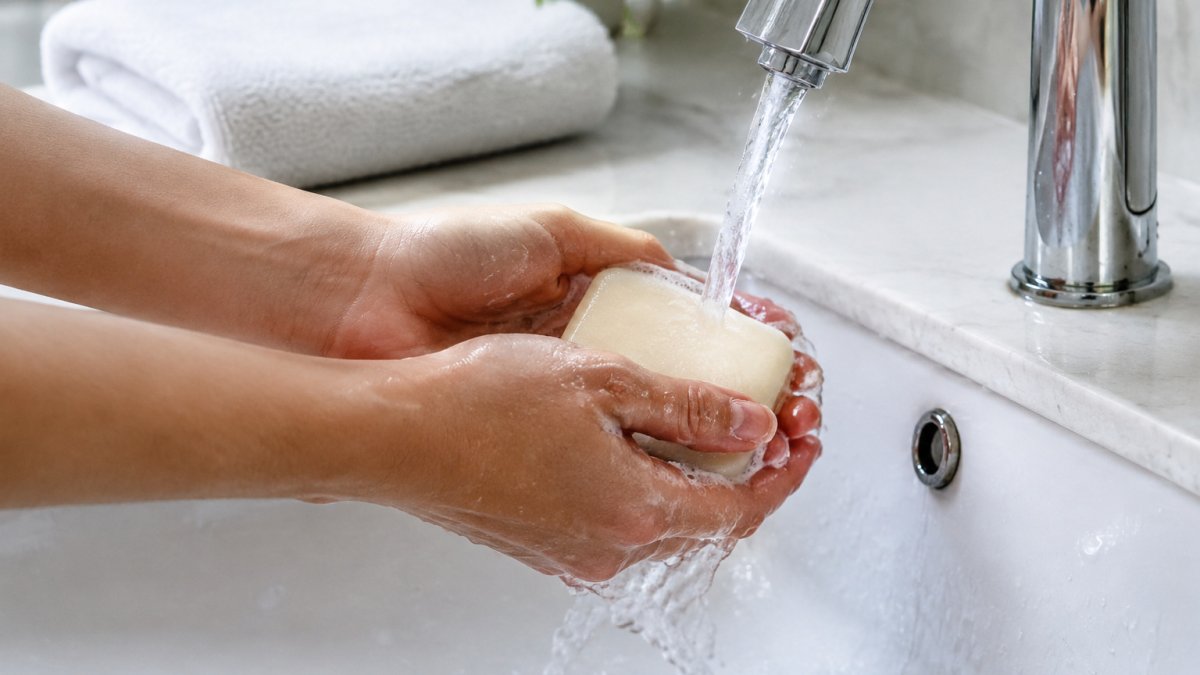
When comparing options, the Nature's Gift Unscented Bar Soap contains no added fragrance, while the rose and lavender liquid cleansers contain fragrance. Introduce any new cleanser one at a time so you can identify what, if anything, causes a reaction.
Nature's Gift Unscented Bar Soap ( 4.5 oz each ) →
Best Soap for Atopic Dermatitis: Bar Soap Versus Liquid Cleanser
The bar-versus-liquid question is really a formulation question, and most product pages skip it. Traditional bar soap is made by saponifying fats with an alkali, which leaves it alkaline, typically around pH 9-10. Skin prefers a mildly acidic surface near pH 4.5-5.5, and that acid mantle supports the enzymes and lipids that keep the barrier intact. A true soap bar can therefore feel "squeaky clean" precisely because it has shifted skin pH and stripped surface oils.
A syndet (synthetic detergent) bar or a mild liquid cleanser is formulated closer to skin pH and uses gentler surfactants such as sodium cocoyl isethionate, cocamidopropyl betaine, or glucosides. Many dermatology-oriented cleansers are syndets for this reason. The trade-off is that syndets often contain more ingredients, including preservatives when water is present, and some people react to those additives even when the surfactant system is mild.
Format matters in practical ways too. Bar soaps are low in water, so they usually need little or no preservative, which is a general property of the format. Liquid cleansers are easier to rinse fully, often include humectants like glycerin, and are less likely to be shared with bacteria, but they require preservation and may carry fragrance or essential oils for scent. Neither format is inherently better for atopic dermatitis; the formulation and your individual tolerance decide it.
A transparent way to compare any two products is a short scorecard: cleanser type (true soap vs syndet), pH if disclosed, surfactant system, fragrance and essential-oil content, preservative system, presence of humectants or barrier ingredients, and intended use (face vs body). Price per use is a fair tiebreaker once the first six are equal. Applying that scorecard to our own range: the unscented bar soap contains no added fragrance; the Beauty Forever Liquid Face & Body Soap with Rose scent and the Nature's Gift Liquid Shower Soap are liquid formats that include rose, peppermint, or lavender ingredients.


Many people with atopic dermatitis end up using a bar for the body and a liquid for the face, or the reverse, depending on which areas feel drier or more reactive. There is no single correct answer, but there is a correct process: identify the cleanser type, check the fragrance and preservative profile, and change only one product at a time so you can tell what helped or hurt.
The article compares the two formats by how they are made and what they contain, which can be summarised as follows.
| Format | Typical pH | Preservative need |
|---|---|---|
| Traditional bar soap | Around 9-10 | Little or none |
| Syndet bar or liquid cleanser | Closer to skin pH | Needed when water is present |
| Skin surface | Around 4.5-5.5 | Not applicable |
Plant-Based Soap for Eczema on the Face
The face has thinner skin than the body and is more prone to irritation, so cleanser choice matters more here. Use a gentle, fragrance-free option, rinse with lukewarm water, and pat dry rather than rubbing. Avoid scrubbing products or anything that leaves a tight feeling.
If your facial skin reacts to a particular cleanser, stop using it and consult a dermatologist before trying something else.
Patch Testing Our Soaps and What to Do If a Flare Starts
Patch testing is a common way to check a new product. Apply a small amount to a discrete area such as the inner forearm once daily for several days, and watch for redness, itching, or swelling. Do not use a product on broken skin during testing.
If a flare starts after switching cleansers, stop using the new product, return to a basic fragrance-free option, and keep moisturizing consistently. Persistent, spreading, or painful symptoms need medical attention.
The general principle is to start simple, test slowly, and change one variable at a time.
Choosing a Gentle Cleanser for Your Routine
A gentle cleanser for eczema-prone skin is usually short on ingredients, free of added fragrance, and easy to rinse fully. Pair it with a regular moisturizer, use lukewarm water, and keep showers brief. Consistency in these basics often matters more than any single product.
For more on calming chronic irritation, read our chronic skin care guide to managing flares, and if you are comparing fragrance-free options, our guide to using a fragrance-free cleanser safely walks through washing technique step by step.
Frequently Asked Questions
Is plant-based soap good for eczema?
Plant-based soap can be gentle, but plant origin alone does not make it suitable for eczema. Soaps made with saponified oils still have a high pH and can strip the skin barrier, and botanical extracts or essential oils can irritate reactive skin. Check the full ingredient list, look for fragrance-free options, and patch test any new product on a small area for several days before using it more broadly.
What kind of soap is best for people with eczema?
For most people with eczema, a fragrance-free, mild cleanser with a short ingredient list is the safest starting point. Products labelled for sensitive skin or atopic dermatitis are usually a better fit than heavily scented bars. Rinse thoroughly, pat skin dry, and apply a moisturiser soon after washing to support the skin barrier. Whether a specific product works for you depends on your own skin, so test it gradually.
Can plant-based soap irritate eczema?
Yes. Essential oils, botanical extracts and certain preservatives are common triggers, even in soaps marketed as natural. Fragrance-free does not always mean irritant-free, so review the full ingredient list. If redness, itching or a rash appears within a few days of starting a product, stop using it and consult a dermatologist if symptoms persist.
What ingredients should people with eczema look for in soap?
Look for fragrance-free formulas and a short ingredient list. Our Nature's Gift Unscented Bar Soap is made with saponified safflower, olive, castor, palm and coconut oils, sodium hydroxide, water and Nature's Gift concentrate, with no added fragrance. Avoid products with added fragrance, essential oils or long lists of botanical additives if your skin reacts easily.
Get Your Life Back LLC formulates its soaps around simple, plant-based oil blends, and our Nature's Gift range includes unscented and lightly scented options so you can match a cleanser to your tolerance. Start with the product that has the fewest ingredients, patch test before full use, and sign in to explore the full range and find the option that suits your routine.

Compartir esta publicación
- Etiquetas: best soap for atopic dermatitis, fragrance-free cleanser for eczema, is plant based soap good for eczema review, plant-based soap, plant-based soap for eczema on face, soap ingredients that trigger eczema