

How to Manage Lyme Disease Skin Symptoms at Home
Publicado por Editorial Team en
Last Updated: October 30, 2026
Quick Summary
To manage lyme disease skin symptoms at home, wash the area once or twice daily with mild soap and warm water, pat it dry, and leave it uncovered unless it oozes. Calm itching with cool compresses, colloidal oatmeal, or a thin layer of hydrocortisone cream, and photograph the rash daily with a ruler for scale. Home care soothes skin but does not treat the infection, so contact a clinician promptly if the rash expands past about 5 cm or flu-like symptoms appear.
- Wash the rash area once or twice daily with mild soap and warm water, then pat dry without rubbing.
- Avoid harsh scrubs, alcohol, hydrogen peroxide, and hot water, which irritate skin and slow healing.
- Cool compresses for ten minutes at a time are the gentlest first step for itch relief.
- Photograph the rash daily at the same time, distance, and angle with a coin or ruler for scale.
- Contact a clinician within a day or two if a rash expands past about 5 cm or fever appears.
Table of Contents
- Understanding Lyme Disease Skin Symptoms
- Lyme Disease Rash Home Care: Cleaning and Protecting the Area
- Lyme Disease Itching Relief Without Aggravating the Rash
- Tick Bite Home Care: What to Do After a Bite
- When to Seek Medical Care for a Lyme Rash
- Tracking Your Rash and Skin Symptoms Over Time
- Choosing Skin Care Products While Managing Lyme Symptoms
- Frequently Asked Questions
Understanding Lyme Disease Skin Symptoms
Learning how to manage Lyme disease skin symptoms at home starts with recognizing what you are actually looking at.
The most common early skin sign is erythema migrans, a spreading rash that often appears within days to weeks of a tick bite.
Other skin symptoms can include:
- A warm feeling at the bite site
- Mild swelling around the rash
- Itching or irritation that comes and goes
- New patches appearing elsewhere on the body
Watch out: a rash that keeps growing past a few days is not a normal bug bite reaction.
Erythema Migrans vs. Common Bite Reactions
Telling these apart matters, because the response is different. A common bite reaction usually peaks fast, within hours to a day. It stays small, itches intensely, and fades on its own within a week or so. Erythema migrans tends to expand slowly, often reaching several centimeters, and can last for weeks without treatment.
Use this quick comparison:
| Feature | Erythema Migrans | Common Bite Reaction |
|---|---|---|
| Onset | Days to weeks after bite | Hours after bite |
| Size over time | Expands slowly | Stays small |
| Itch level | Mild to moderate | Often intense |
| Duration | Weeks without treatment | Days to a week |
| Pattern | Sometimes bull's-eye | Usually a small bump |
If you are unsure which one you are looking at, photograph it daily and let a healthcare professional decide. Guessing costs time.
Lyme Disease Rash Home Care: Cleaning and Protecting the Area
Gentle cleaning is the foundation of Lyme disease rash home care. Keep the area clean, keep it dry, and keep your hands off it. That is the whole job.
Here is the routine we suggest:
- Wash the area once or twice daily with mild soap and warm water.
- Pat dry with a clean towel. Do not rub.
- Leave it uncovered unless it is oozing or in a spot that rubs on clothing.
- Apply a thin layer of a gentle, fragrance-free moisturizer if the skin feels tight or dry.
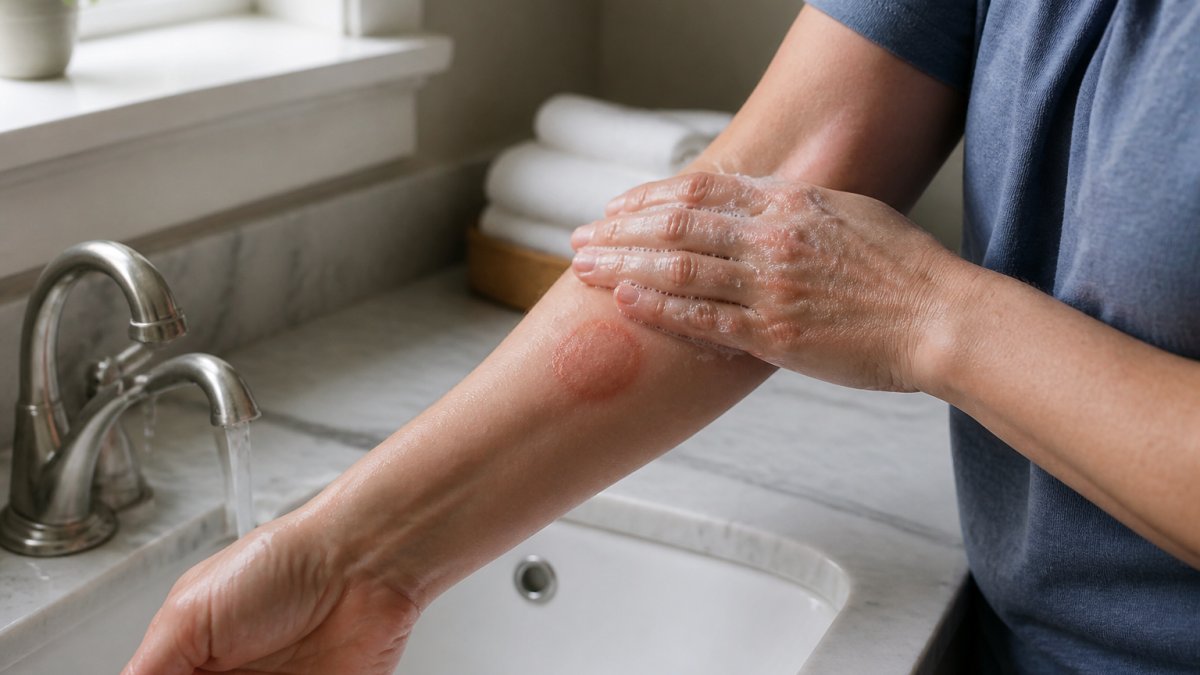
Avoid harsh scrubs, alcohol, hydrogen peroxide, and hot water. A gentle moisturizer can help protect the area while it settles; our Nature's Gift Skin Lotion is a coconut oil-based lotion you can massage into the skin as needed.
Lyme Disease Itching Relief Without Aggravating the Rash
Itch relief for Lyme disease skin symptoms should calm the skin without breaking it. Scratching opens the skin to infection and makes everything worse. The goal is comfort, not silence.
Try these, in order of gentleness:
- Cool compress: a clean cloth with cool water, ten minutes at a time.
- Colloidal oatmeal: add to a lukewarm bath for widespread itch.
- Over-the-counter hydrocortisone cream: thin layer on small itchy patches.
- Oral antihistamine: useful at night when itch keeps you awake.
- Keep nails short: the simplest way to limit damage from scratching.
Avoid scratching, and avoid tight clothing over the rash. Heat and sweat make itch worse, so keep the room cool.
Tick Bite Home Care: What to Do After a Bite
Found a tick? Remove it promptly and clean the bite area. Quick, careful removal lowers the chance of infection.
Step by step:
- Use fine-tipped tweezers. Grasp the tick as close to the skin as you can.
- Pull straight up with steady pressure. Do not twist or jerk.
- If mouthparts stay behind, leave them. The skin will push them out.
- Clean the area with mild soap and warm water or an antiseptic.
- Save the tick in a sealed bag or small container. Note the date.
- Watch the site for the next few weeks and photograph any change.
Do not apply petroleum jelly or burn the tick off; those methods do not work and can irritate skin.
When to Seek Medical Care for a Lyme Rash
Home care soothes skin; it does not treat the Borrelia infection. The single most important decision you will make is when to stop managing at home and involve a clinician. Use the tiers below to sort a routine call from a same-day visit from an emergency.
Tier 1: Contact a clinician promptly (within a day or two)
Reach out if you have any of the following, even if the rash looks mild:
Nature's Gift Skin Lotion ( 8 oz & 1.5 oz ) →
- A rash that has expanded over several days, especially past about 5 cm (2 inches)
- A bull's-eye or target-like pattern, or any ring that grows while the center clears
- Flu-like symptoms after a tick bite: fever, chills, headache, fatigue, muscle aches, or joint pain
- A bite site that is increasingly red, warm, swollen, or tender
- New patches appearing elsewhere on the body
- A tick that was attached for more than 24 hours, or an engorged tick
Early treatment is simpler and more effective than late treatment. Readers managing symptoms at home can explore the Natures Gift® Spring Tail Collembola Lyme Pack.
Tier 2: Same-day or urgent care
Do not wait for a routine appointment if you notice:
- A rash spreading rapidly over hours
- Fever above 38°C (100.4°F) with worsening rash or pain
- Signs of a skin infection at the bite site: spreading redness, streaking, pus, or increasing warmth
- Severe headache, neck stiffness, or sensitivity to light
- New facial drooping, numbness, or weakness
- Heart palpitations, chest discomfort, dizziness, or fainting
- Joint swelling that is sudden and severe
These can signal disseminated Lyme disease or another condition that needs prompt assessment. When in doubt, call and describe the symptoms; clinicians are used to triaging tick-related concerns.
Tier 3: Emergency care
Call emergency services for:
- Difficulty breathing, throat swelling, or widespread hives (possible allergic reaction)
- Confusion, fainting, or seizure
- Severe chest pain or an irregular heartbeat with dizziness
- Rapidly spreading rash with high fever and feeling very unwell
What to bring to the visit
Bring your photo log (see the tracking section), the date of the bite if known, the tick in a sealed bag if you saved it, and a list of any medications or supplements. Tell the clinician about all skin symptoms, not just the one that prompted the visit.
Tracking Your Rash and Skin Symptoms Over Time
Photo tracking turns guesswork into a record a clinician can act on. Most people cannot reliably remember whether a rash grew yesterday, but a dated photo sequence answers that question in seconds. This is one of the most useful things you can do at home, and few guides explain how to do it well.
How to take useful rash photos
Consistency matters more than camera quality. Follow this routine:
- Same time each day. Pick a time when lighting is similar, such as mid-morning near a window.
- Same distance and angle. Hold the camera the same distance from the skin and shoot straight on, not at an angle.
- Include a scale reference. Place a coin, a ruler, or a small card with a known size next to the rash in the frame.
- Use indirect, even light. Avoid direct sun, flash glare, or harsh overhead light that washes out color.
- Take one wide shot and one close-up. The wide shot shows location and context; the close-up shows border and color detail.
- Do not edit or filter. Keep the original file; filters distort color and size.
-
Label the file with the date (for example,
rash-2026-10-30.jpg) so the sequence sorts correctly.
How to measure the rash
- Use a soft ruler or measuring tape and record the longest diameter in centimeters.
- For irregular shapes, measure the longest dimension and the widest perpendicular dimension.
- Note whether the border is sharp or blurred, and whether the center is clearing.
- If the rash is in a hard-to-reach spot, ask someone to help or use a mirror with good light.
What to record in a daily log
A simple note or spreadsheet is enough. Track:
- Date and time of each photo
- Measured size (cm) and location
- Color and border changes (for example, "edge darker, center fading")
- Itch or pain level on a 1-10 scale
- Any new symptoms elsewhere: fever, fatigue, joint pain, headache
- Anything that seemed to trigger a flare (heat, stress, new fabric, scratching)
Why this helps your clinician
The question clinicians ask most is whether the rash is growing. A dated photo series with measurements shows the trend clearly and can reduce the need for repeat visits. It also helps you notice patterns, such as flare-ups after heat or stress, and gives you a factual record if symptoms change after starting antibiotics.
If you are unsure whether a rash is changing, the photo log is the safest way to let a healthcare professional decide rather than guessing.
Choosing Skin Care Products While Managing Lyme Symptoms
Choose products that clean gently and protect the skin barrier. Skip anything with heavy fragrance, alcohol, or harsh exfoliants. During a flare, simpler is better.
What to look for:
- Fragrance-free and hypoallergenic formulas
- Mild, non-stripping cleansers
- Non-comedogenic moisturizers
- Short ingredient lists you can read
Our flagship Nature's Gift® Debriding Soap uses a proprietary liquid bio-form carbon process, with a particle size of 6 angstroms. It is designed to deep clean and remove debris from pores, and it is non-comedogenic and hypoallergenic. For daily use, we suggest the Nature's Gift Unscented Bar Soap, and the Nature's Gift Skin Lotion for moisturizing after washing.
Watch out: no skincare product treats a Borrelia infection. Skin care supports comfort; antibiotics treat the infection. Keep those roles separate.
Skin symptoms from a tick bite can be confusing. Get Your Life Back LLC builds plant-based, non-comedogenic skin care: deep-cleaning formulas that support normal skin function.
Frequently Asked Questions
Can home remedies treat Lyme disease?
No. Home care can soothe skin symptoms such as redness and itching, but it cannot clear the Borrelia infection that causes Lyme disease. Antibiotics prescribed by a healthcare professional are the primary treatment for the infection itself. Use home care only as comfort support alongside medical treatment, not as a replacement. If you suspect Lyme disease, contact a doctor promptly, especially if you noticed a tick bite or an expanding rash.
How do I know if a Lyme disease rash is getting worse?
Watch for the rash expanding in size, spreading to new areas, or becoming increasingly warm, swollen, or painful. New or worsening fever, headache, fatigue, muscle aches, or joint pain also signal that the infection may be progressing. Take a dated photo each day so you can compare changes objectively. If any of these signs appear, contact a healthcare professional rather than continuing home care alone.
What should I put on a Lyme disease rash?
Keep it simple: mild soap and warm water for cleaning, and a plain moisturizer if the skin feels dry or irritated. Over-the-counter hydrocortisone cream or an oral antihistamine may ease itching, but check with a pharmacist or doctor first. Avoid harsh scrubs, alcohol, hydrogen peroxide, and unproven remedies, which can irritate skin further.
Does a Lyme disease rash go away with antibiotics?
In most cases, erythema migrans fades within days to weeks of starting the prescribed antibiotic course. Finish the full course even if the rash clears early, because the infection may still be present. Some people notice lingering skin irritation or dryness after the rash fades, which gentle cleansing and moisturizing can help manage. If the rash worsens or new symptoms appear during treatment, tell your doctor promptly.

Compartir esta publicación
- Etiquetas: how to manage lyme disease skin symptoms at home, lyme disease itching relief, lyme disease rash home care, lyme disease skin, tick bite home care, when to seek medical care for a lyme rash